★ The Bamboo Annals is Wang Shuo’s work of self-transcendence and a new literary pinnacle for him!
If The Chronicle of the Beginning is “Wang Shuo the historian,” The Bamboo Annals is “Wang Shuo the writer,” representing a new literary pinnacle for him.
★ The history books say only, “The Son of Heaven lodged on the great plain for three months.” Wang Shuo turns those eight words into an epic journey spanning all of history:
Riding across the Eastern European steppes,
Eating seal sashimi by the Baltic Sea,
Encountering Phoenician kidnappers in Greece,
Singing antiphonally with King Solomon on the Temple Mount...
Wang Shuo’s imagination roams across ten thousand leagues, leaving no place beyond its reach.
★ Characters with a thousand different faces: unlike a story centered on a single protagonist, Wang Shuo creates an ensemble of stars.
★ A masterful command of language: he takes on readers with “proper Chinese that won’t make your ears hurt.”
★ A road movie on paper, riding freely across the page, and a dream of searching for home by retracing one’s past.
· From Haojing to Babylon, from the Ruoshui River to the Baltic Sea, from the Kunlun Mountains to the Ural Mountains... King Mu of Zhou and Li Er travel together, singing elegant songs, astride spirited horses and dressed in fine furs.
· From The Classic of Mountains and Seas to the Book of Kings, from the Book of Changes to the Dialogues, from Xia Xiaozheng to the Avesta... Wang Shuo uses literature to awaken the dawn of a bygone age, asleep in Chinese and foreign classics alike.
I once boasted to someone that I would start writing from where the Grand Historian began and work my way backward. The Bamboo Annals is the only surviving comprehensive chronicle from before the Qin dynasty, apart from the Zuo Commentary, to have survived the burning of books under the Qin. The Mu Tianzi Zhuan was unearthed alongside the Bamboo Annals. It records, day by day, King Mu of Zhou’s journey west to the Tianshan Mountains to meet the Queen Mother of the West, and his journey beyond the mountains to the great wilderness in the northwest. The Bamboo Annals is archaic and obscure, and not a word could be spared. You can read it for ages and feel as though you have read nothing at all. But if you study history without reading the Bamboo Annals, you’ll miss a lot. I’m here to embellish it with a little color and make it an enjoyable read. The Bamboo Annals takes the Bamboo Annals and the Mu Tianzi Zhuan as its framework, covering the period from the Five Emperors to the fourteenth year of the Gonghe era, where reliable Chinese history ends., Wang Shuo
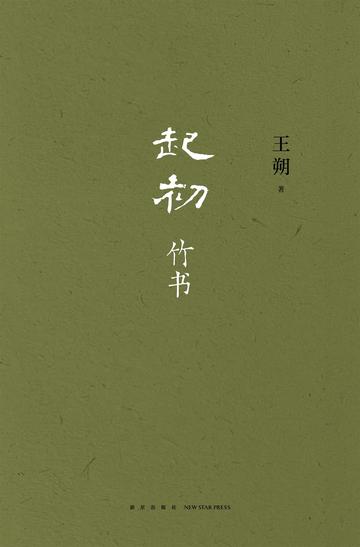
The Bamboo Annals is the second volume in the four-volume novel series The Beginning. This volume draws on the Bamboo Annals and the Mu Tianzi Zhuan.
Based on these two historical texts, Wang Shuo tells a variety of stories from the age of the Five Emperors through the Gonghe era of the Western Zhou dynasty. From Yao and Shun’s abdication to Hou Yi’s overthrow of the Xia, from Yi Yin’s banishment of Taijia to the reigns of Cheng and Kang, from King Mu’s western expedition to the Gonghe regency of the Duke of Zhou and the Duke of Shao, Wang Shuo breathes life into terse, archaic historical texts with his boundless imagination. Hou Yi, Bo Mi, the Duke of Zhou, King Mu, Li Er, and many others who existed only in ancient texts or even in myth appear before us in all their vivid glory. In particular, inspired by the eight words “The Son of Heaven lodged on the great plain for three months” in the Mu Tianzi Zhuan, Wang Shuo creates the section about King Mu’s western expedition. This epic journey across the Eurasian continent reveals a bold vision connecting heaven and earth and the grand spirit of a world united across a thousand miles.


This book may be a bit challenging for readers who are accustomed to traditional narratives. The ancient historical materials and jumping thinking also need to be adapted. But this is its unique charm: it does not let you passively accept history, but invites you to enter Wang Shuo's mind and gallop with him in the wilderness of history.
Beautiful, love watching. Luo Guanzhong performed the Three Kingdoms, and Wang Shuo performed the Bamboo Book.