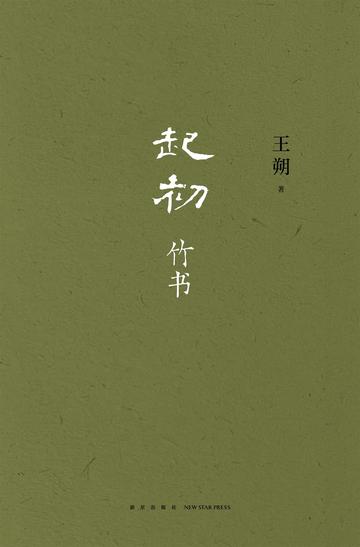
★"The Bamboo Book at the Beginning" is Wang Shuo's work of self-transcendence and a new literary peak for Wang Shuo!
If "Chronicles of the Beginning" is the "Wang Shuo of history", "Bamboo Book of the Beginning" is the "Wang Shuo of literature", representing Wang Shuo's new literary peak.
★There are only eight words in the history book: "The Emperor died in Kuangyuan in March", but Wang Shuo turned it into a super wandering that spans the past and the present——
Galloping on the grasslands of Eastern Europe,
Eating seal sashimi in the Baltic Sea,
Encountered Phoenician kidnappers in Greece,
Singing with King Solomon on the Temple Mount...
Wang Shuo's heart traveled thousands of miles, and there was no limit to what he could reach.
★Character creativity with thousands of people and faces - Different from the story of one protagonist, Wang Shuo created a group of star-like protagonists
★Profound language and writing skills - use "I don't listen to serious Chinese" to compete with readers
★ A road movie about riding a horse on paper, a self-retrospective dream of finding home
· From Haojing to Babylon, from Ershui to the Baltic Sea, from Kunlun Mountain to the Ural Mountain... King Mu of Zhou Dynasty Li Er and his party sang in harmony, and their angry horses were light-furred;
· From "The Book of Mountains and Seas" to "The Chronicles of Kings", from "The Book of Changes" to "Dialogues", from "Xia Xiaozheng" to "Avesta"... Wang Shuo used literature to awaken the Haochu era that was sleeping in Chinese and foreign classics.
I once boasted to others that I had written from the place where Taishi publicly wrote. "Bamboo Book Annals" is the only surviving pre-Qin chronological general history after the Qin Dynasty, except "Zuo Shi Chun Qiu". "The Biography of Emperor Mu" was unearthed at the same time as the Bamboo Book. It records day by day that King Mu of Zhou traveled west to the Tianshan Mountains to meet the Queen Mother of the West, and then left the Tianshan Mountains to the vast plains of the northwest. The bamboo book is an ancient book, with not a single word in it. After reading it for a long time, I still don't understand anything. But if you read history without reading bamboo books, you will not know many things. Let me add oil and matcha to it to make it easier to read. "In the Beginning: The Bamboo Book" takes the Bamboo Book and the Biography of Emperor Mu as its backbone. From the Five Emperors to the 14th year of the Republic of China, China has no history of trust. ——Wang Shuo
"The Bamboo Book" is the second volume in the four-volume series of novels "The Beginning". This volume is based on "The Bamboo Book Chronicles" and "The Biography of Emperor Mu".
Based on these two historical books, Wang Shuo told various stories from the era of the Five Emperors to the Republic of the Western Zhou Dynasty. From Yao and Shun's abdication, to Hou Yi's replacement of Xia, from Yi Yin's release of Taijia, to the rule of Cheng Kang, from King Mu's western tour, to Zhou's call for the Republic, Wang Shuo used his extremely rich imagination to give vitality to the extremely simple ancient Austrian history books. Let Hou Yi, Bo Mi, Duke Zhou, King Mu, Li Er and many other characters who only exist in classics or even myths appear before us vividly. In particular, the part about Emperor Mu's Western Tour created by Wang Shuo was inspired by the character "The Emperor died in the wilderness in March" in "The Biography of Emperor Mu". It is an epic journey across the Eurasian continent, showing the heroic vision of the world and the majestic spirit of traveling thousands of miles with the same wind.
Reader comments
This book may be a bit challenging for readers who are accustomed to traditional narratives. The ancient historical materials and jumping thinking also need to be adapted. But this is its unique charm: it does not let you passively accept history, but invites you to enter Wang Shuo's mind and gallop with him in the wilderness of history.
This book may be a bit challenging for readers who are accustomed to traditional narratives. The ancient historical materials and jumping thinking also need to be adapted. But this is its unique charm: it does not let you passively accept history, but invites you to enter Wang Shuo's mind and gallop with him in the wilderness of history.