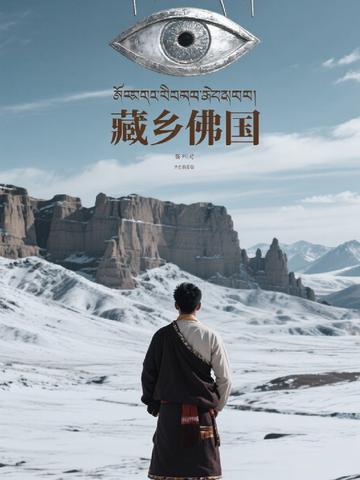
Thangka painter Ling Feng was invited to participate in the Tibetan Intangible Cultural Heritage Annual Conference and unexpectedly received half of a Kalachakra Thangka. He was involved in the dispute between Buddha and Ben and the conspiracy of an alien civilization that spans thousands of years. The vajra brush and mysterious notes left by his father, and the secret behind his mother's nuclear physics research, pushed him into the dual vortex of spiritual practice and exploration.
On the way to practice, he awakened the body secret inheritance of Vajrasattva, caused the body to be burned by the kundalini fire in the double cultivation, and realized the rainbow transformation in the visualization; during the exploration, the silver eye curse of the Changtang grassland, the interstellar ruins of the Guge Dynasty, and the time and space cracks of Kailash emerged one by one. The Bon Religion, the remnants of the Nazis, and other forces are surrounding them, but the Silver Eyes are actually the external manifestation of their inner demons, and the Nine-fold Nether Ruins are the embodiment of the ignorant obsessions of all living beings.
Ling Feng used the three-secret inheritance as the key to get rid of his ego in thangka painting and life-and-death tests, and finally rewrote the contract with rainbow light, sublimating the alien crisis into a test of xinxing cultivation. When the snowy morning light illuminates the Regong studio, a new thangka is painted, and the inherited fire continues to burn between the canvases.
Reader comments
The novel cleverly combines mysterious elements, historical metaphors and adventure narratives to create a dark world full of religious mystery and human nature. Using an almost line drawing method, the "Ice Mandala" of Namtso Glacier Lake, the bloody murals of the Guge Mi Caves, the twisted remains of Nazi members and other scenes are outlined, interweaving the sanctity and terror of Tibet. Through multi-line texts such as "Notes of the German Scientific Expedition Team in 1951" and "Nazi Diary of 1938", the encounters of modern explorers are nested with historical events, forming a double suspense of intertwined time and space. The novel weaves a fable about "gazing and being stared at" and "protection and destruction" through Tibetan secret elements such as the Nine-Eyed Dzi Bead, Vajrasattva Body Secret, and Ajie Drum.
The novel cleverly combines mysterious elements, historical metaphors and adventure narratives to create a dark world full of religious mystery and human nature. Using an almost line drawing method, the "Ice Mandala" of Namtso Glacier Lake, the bloody murals of the Guge Mi Caves, the twisted remains of Nazi members and other scenes are outlined, interweaving the sanctity and terror of Tibet. Through multi-line texts such as "Notes of the German Scientific Expedition Team in 1951" and "Nazi Diary of 1938", the encounters of modern explorers are nested with historical events, forming a double suspense of intertwined time and space. The novel weaves a fable about "gazing and being stared at" and "protection and destruction" through Tibetan secret elements such as the Nine-Eyed Dzi Bead, Vajrasattva Body Secret, and Ajie Drum.