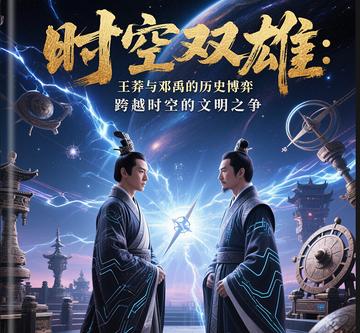
Spanning three eras, the Western Han dynasty, the modern day, and a future among the stars, the story follows “fluorescent genes” and “spacetime beacons” as its central threads. It depicts a cross-dimensional contest between Wang Mang, the “Seeder,” and Deng Yu, the “Observer,” over how civilization should endure.
Built on hard science fiction concepts such as quantum-state bioluminescence, entropy-fog pruning, and four-dimensional counting-rod models, the work incorporates historical elements including the counting-rod philosophy of the Zhoubi Suanjing and the Western Han technological revolution. It explores the ultimate question: should civilization choose to break through or to preserve itself? In the ending, a wheat field at 36.5 degrees north latitude becomes the origin of a cosmic symbiotic network. The awns of every rice stalk shimmer with the genetic code of a cross-dimensional civilization, echoing the opening metaphor that “for civilization to endure, someone must dare to sow seeds at the edge of a cliff.” The story ultimately rises into an epic vision: “In the river of spacetime, sowing and safeguarding are both the heartbeat of civilization.”