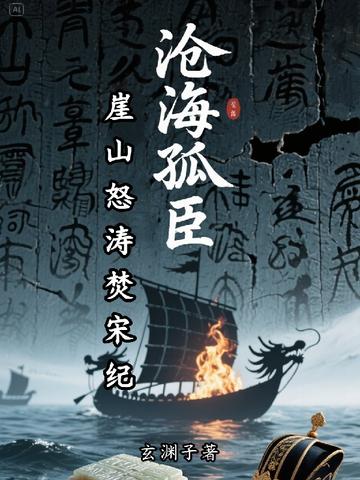
When the Mongolian artillery blasted the remaining pages of "The Analects of Confucius" into the city of Xiangyang, the backbone of Chinese civilization began to tremble for the final time. This is not a dynasty change in history books, but a civilizational nirvana soaked in blood, fire and poetry - the six-year-old emperor recited "Mencius" on a dragon boat, the prime minister wrote a death memorial in shark skin, and a hundred thousand scholars sank into the deep sea holding classics, using Confucian crowns to build invisible monuments in the roaring waves.
From the fall of Xiangyang in the ninth year of Xianchun to the decisive battle at Yashan in the second year of Xiangxing, history fissured in turbulent waves: on the night when Lin'an City was destroyed, Wen Tianxiang cut off the iron chain of the palace lantern, and sparks ignited the fragments of "Along the River During the Qingming Festival"; the dragon boat traveling on the sea drifted with the manuscript of "Zhu Zi Yu Lei", and Lu Xiufu dipped in the sea water to review the memorial; until the Persian merchant's logbook recorded the doomsday spectacle of "Oriental knights burning history and crossing the sea".
But there is a truth buried in the deep sea that subverts our understanding: in a shipwreck of the late Song Dynasty that was salvaged in the South China Sea in 2023, a blood letter on the bottom of a celadon bowl actually pointed to the shocking and mysterious trace of the jade seal passed down from the country. Modern scholars followed three mysterious clues - the star map smuggled by Japanese monks, the "Book of Changes" code on the rhinoceros armor of the Champa, and the child's tooth marks on the keel of the sunken ship - and gradually uncovered the hidden chapters erased by historians: Zhang Shijie's burned "History of the Song Dynasty" contained drawings of fire dragons emerging from the water, peony seeds in Empress Dowager Yang's hairpin sprouted in the American continent, and 100,000 volumes of classics under the whirlpool of the cliff mountain were turning into coral reefs, holding up the ark of a new civilization.
This work uses archaeological suspense to strike at the mezzanine of history. In the ultimate showdown between the Mongolian cavalry and the lonely ministers at sea, it rewrites the alternative possibility for the survival of civilization...