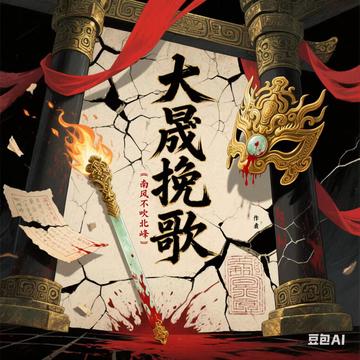
"The Long Song of Dasheng" is a long narrative work that blends historical machinations and fictional epics. It takes the fictional dynasty "Dasheng" as the stage, interweaves the institutional texture and power logic of the Han, Tang, Ming, and Qing dynasties, and unfolds a civilizational game that spans three volumes and runs through sea and land.
The story begins with the celestial warning of "Ying Huo Shou Xin". Xiao Heng, an official from a poor family, is trying to turn the tide with reforms such as the "Ten Strategies for a Poor Family" and the "Qing Tian Law" in the triple strangulation of the imperial power crisis, the separatist regime of Liang King, and the corruption of the gentry. From the economic secret war with the interception of the Yellow River disaster relief funds to the religious biological warfare of the White Lotus Sect's "Blood Lotus Gu"; from the firearms showdown on the Taiwan Strait battlefield to the voiceprint monitoring and genetic manipulation deep in the palace, the plot is permeated with the deconstruction and reconstruction of historical events such as Wang Anshi's reform, Zhang Juzheng's reform, and Zheng Chenggong's anti-Japanese war.
The work takes "technological alienation" and "colonial infiltration" as the dual main lines to construct a complex power map: the spice trade chain of the Dutch East India Company, the "iron gun ashigaru" of the Japanese ronin, the arms smuggling network of the Huns and nobles, and fierce collisions with technical systems such as the "Flying Fish Secret Box" of the Jinyiwei of the Dasheng Dynasty and the "Yangsui Development Technique" of the Qin Tianjian. In the gap between the collapse of the system and the annihilation of civilization, Xiao Heng, Shen Qinglan, Lu Chengyuan and other figures, with the tragic gestures of "building a long embankment with bones" and "burning the sky with blood edicts", tried to open up a path of survival beyond the laws of historical cycles between the ideal of "equal land and free grain" and the reality of "hereditary power".