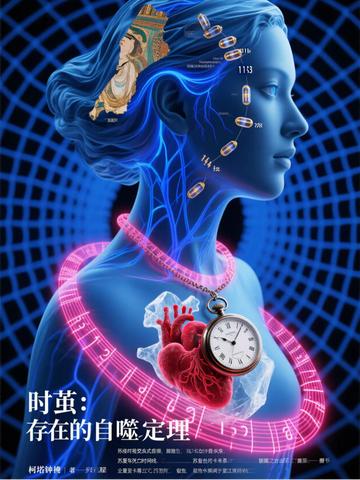
When quantum physicist Su Xia's left hand passed through bulletproof glass, her father's pocket watch was spinning counterclockwise inside a vacuum chamber, exuding the scent of Montblanc ink he had always used before he disappeared. Seven time capsules parasitic in her life were rewriting her memories into a calcified tree growing backward: the Chernobyl sarcophagus held the radiation dose from her first unsteady steps, the 6,314th layer of Antarctic ice recorded the entropy of her first kiss, and the quantum-dot array in her iris was replaying her father's final lie in Morse code.
As she traversed the folds of the time archive known as the "Klein Dome," every attempt to save her father created a paradoxical ghost: the 113th fold in the Dunhuang murals seeped with the love letter she never sent, while the DNA helix of moss on Turing's tombstone engraved her obituary from 2033. The network of blue veins spreading behind her ear warned her that all time travelers would eventually hear their parallel selves' dirges.
When the seventh capsule awoke in a crater on the space station, the watch, suspended upside down, revealed the ultimate truth: her father was merely a fragment of her own consciousness, scattered among the time crystals of the future. The girl who taught her to deconstruct rainbows, the man swallowed by a calcified cocoon on a stormy night, the ghost weaving quantum forceps at the cosmic singularity: every version of Su Xia across time had carved the same warning into Heidegger's unpublished manuscripts: "Don't let your palm lines leave fingerprints on the light cone."
Right now, your phone is growing warm. In the photo sent from an unknown number, these words are quantum-dissolving between your fingers. In the background, half a fingerprint formed by blue veins is vibrating in sync with the warmth of the raised spot behind your ear.