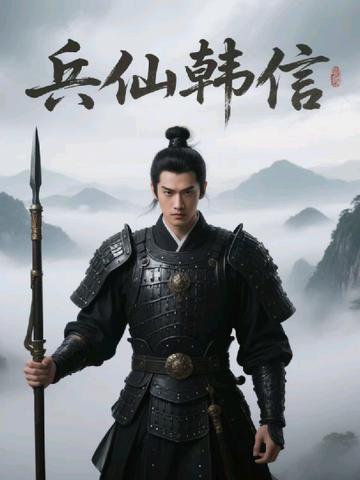
Introduction to "Soldier: Han Xin"
On the bluestone slab on the street of Huaiyin, young Han Xin clenched his rusty sword tightly, spinning in the alley while listening to the scolding of the evil young man. He didn't know that this humiliating moment of "crotch drilling" would become a footnote written repeatedly in history books in the future – at this moment, he was just a poor man who even had to borrow his mother's cornbread on credit. His worn-out shoes had stepped on the remaining pages of the Spring and Autumn Art of War, and in the moonlight leaking from the ruined temple, he had carved the four words "go to the altar to worship the general" into the cracks of the bricks.
No one thought that this little soldier who once took a nap carrying a halberd in the Chu camp would be chased back by Xiao He on an autumn night in Hanzhong, and step onto the general stage with the eyes of thousands of Han troops. He deceived King Bao of Wei with the wooden poppy crossing army, and forced out the fear of 200,000 Zhao soldiers by forming an array at the entrance of Jingxingkou. In the sound of Chu songs, he laid out a deadly situation of ambushes from all sides, and watched Xiang Yu's black horses crush the last ray of moonlight. History books say that "the more the merrier," but they don't mention that his finger was bitten by a mouse while he was squatting in the grain depot counting brown rice. They don't mention that he was scolded as "a general doesn't look like a general" when he was soaking the feet of wounded soldiers. They didn't mention that he took a nap on his horse while carrying his mother's nest, dreaming that he was still the boy stealing fish by the Huaiyin River.
But when the seal of the King of Qi was replaced by the patched court uniform of the Marquis of Huaiyin, and when the candlelight in the Weiyang Palace reflected the gold-threaded dragon pattern on Queen Lu's sleeves, he finally understood that a soldier who thought he had perfect strategies on the battlefield could not understand the emperor's heart after all. The white silk from Changle Palace carries the scent of acacia flowers from the Hou Mansion, which was made from old quilts by the soldiers. The charcoal basin was kicked over before dying, and the sparks splashed on the Dongzhu that was paid tribute back then, burning a hole that can never be repaired.
This is not the cold "soldier god" in the history books.