I was eighteen years old when I left Linjia'ao. I thought I would never return to this mountain village with so many suffocating rules.
Until a phone call in the early morning dragged me back to the mountains where my ancestors and taboos are buried.
Grandma only left seven death rules before her death:
If you knock on the door in the middle of the night, don't open it. If the incense breaks, don't bury it. If you look at red clothes without raising your eyes, if you turn around in the ancestral hall, don't look back.
Don't count heads under the moonlight, don't look at the reflection in a well for too long, don't stop gossiping in front of the grave.
I was going to a funeral, so I just wanted to get over it quickly and return to the city as soon as possible.
But on the first night of vigil, a figure appeared in the courtyard, someone called my name softly outside the door, and a red dress stood under the eaves of the ancestral temple.
There was inexplicably half a piece of fragrance in the palm of my hand, and a bone-deep cold pressed on my shoulders.
The people in the village looked at me with half awe and half dodge.
I slowly understood——
The ancestral temple in Linjia'ao is not for incense, but for the blood debt owed a hundred years ago;
What I guard is not the ancestral hall, but the lives of the whole village.
If one rule is broken, a whole family will die.
When the lights go out, people die, temples collapse, and villages die.
From then on, I held the lamp and guarded the temple, not daring to make any mistakes.
When the lights are there, people are there; when the lights go out, everything stops.
Reader comments
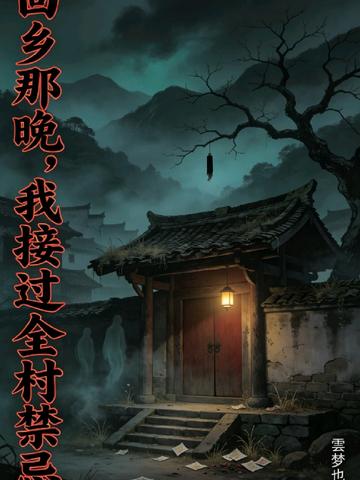
Yun Mengye's "The Night I Returned to My Hometown, I Take Over the Village's Taboo" is an excellent work of Chinese folk horror. Remote mountain villages, strict taboos, and weird and strange things form a creepy world. The protagonist struggles to break out of a desperate situation, the plot is interlocking, and the atmosphere is exaggerated to the extreme. There is a chill between the lines, and every page grips the heart, making people unable to stop in horror and curiosity.
Yun Mengye's "The Night I Returned to My Hometown, I Take Over the Village's Taboo" is an excellent work of Chinese folk horror. Remote mountain villages, strict taboos, and weird and strange things form a creepy world. The protagonist struggles to break out of a desperate situation, the plot is interlocking, and the atmosphere is exaggerated to the extreme. There is a chill between the lines, and every page grips the heart, making people unable to stop in horror and curiosity.