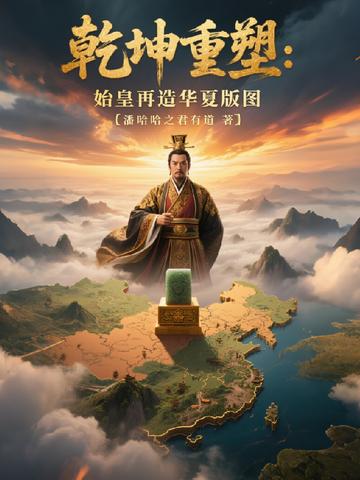
Dr. Li Yan, a doctor of modern history, traveled to Qin Shihuang and reversed history when the Six Kingdoms were first established. He abolished the ban on expelling guests and replaced them with "recruiting talents for hundreds of jobs." He used blast furnaces to make iron to improve the weapons of the Qin army, and used stirrups to reshape the cavalry's combat power. He also laid a Sanhe earth roadbed on the Qin Straight Road and introduced modern surveying and mapping to the Ling Canal, turning infrastructure into a link for civilization penetration. He promoted the "new official script + pinyin" writing reform and set up bilingual classes at Nanjun Academy so that Yue children could read together "the same text and the same mind."
After the Baiyue was pacified, 500,000 Qin troops were disarmed and stationed in the fields. They married the Yue people and established the "Rongmin Tian" system. The city of Panyu gradually became the cultural melting pot of the Qin and Yue communism. The "Hu-Han Mutual Market Month" was set up in the northern Xinjiang. Iron tools were exchanged for war horses, but the Xiongnu were taught textile skills, and tribal youths were ordered to wear Han clothes to herd. Before his death, he carved the territory of modern China into the jade seal passed down to the country, predicting that "the future generations will expand to the South China Sea." When the jade seal sank in the Weishui River, the word "China" reflected the moon and became a prophecy.
Liu Bang entered Xianyang and obtained the "Minutes of the Territory" collected by Li Yan, which contained the prototype of the provincial system; Zhao Tuo established the "Qin Yue Council" in South Vietnam, and the people freely chose their customs but shared the worship of the First Emperor. This work subverts the narrative of "violent Qin": the burning of books is actually the translation and preservation of classics, heavy labor is paid, and the system of counties and counties runs parallel to the feudal system to form "two monarchs co-governing". When science and technology are bones and fusion is blood, the Qin Dynasty in the Bronze Age became the embryo of a "pluralistic unity" civilization. The word "Huaxia" on the sails of the South China Sea is spreading the fire of civilization far and wide with the monsoon.