


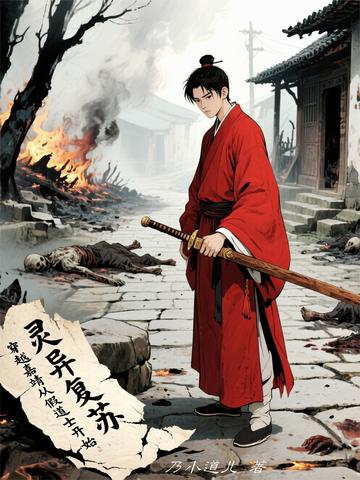
Supernatural Revival: I Transmigrate to the Jiajing Era and Start Out as a Fake Taoist
灵异复苏:穿越嘉靖从假道士开始
- Status
- Ongoing
- Length
- 1.1M Words
- Genre
- Historical
- Subgenre
- Historical High-Concept
- Updated
- 10mo ago
- Source
- Fanqie
Stats
537Chapters
75Reads
6.9Score
1Listens
115.6kReads · all time
Tags
Synopsis
In booklists 5
Taoists, Taoist Arts, Transmigration, No Urban Setting, Supernatural or Paranormal
401Books10.3MViews3dUpdated

I Want Stories About Taoist Priests, Not Livestreaming. Everything Has to Be Livestreamed These Days, and I'm over It
490Books15MViews8dUpdated
Books About the Jiajing Emperor of the Ming Dynasty
51Books309.5kViews12dUpdated
Novels Like The Fate of the Mortal World
42Books683.2kViews2moUpdated

These Books Are Great. If You’re Out of Things to Read, Give Them a Try
Xiaodao Chao Jidan's new book is great. I'm loving it.
220Books3.3kViews1yUpdated
Reader comments 55
Google Translate
The writing is very good. There are no high-frequency turning words in good writing. Whenever "because so although but after all but for example if that's the case" appears at the beginning of a paragraph or in a short series of short sentences, it is a complete waste of time to give up decisively.
It seems to be about time travel, but it is actually about a different world called the Ming Dynasty where there are mysterious and ghostly creatures. The focus of the story is not on the protagonist. He is just a thread that connects people and events. The novel shows an extremely real and bizarre Ming Dynasty.
Very interesting, a bit like the style of Qidian, spreading out the world view bit by bit
The tempo was too slow, so the score was too low. It takes more than 100 chapters to get to the point where it feels good. It took more than 60 chapters to get the rhythm. But it has strong stamina, and now that I have read more than 270 chapters, the novel has gradually entered a good state.
Reading this book is more difficult than reading. I just don't know when the protagonist will be able to stand up. As the person said, the author's writing skills are so good, which makes people look forward to how he will take off in the later period.
1. The subject matter is good, and it is easy to attract the audience. In the context of supernatural resurrection, I meet the emperor who wants to become an immortal the most. If the protagonist has more content to show his sage in front of others or improve his character, it will be very interesting. Unfortunately, the author's writing skills are not enough. He wants to write a group portrait scene but cannot express the feeling. Instead, it is a bit foggy, which consumes patience. 2. The background design of the characters is great, but the growth of the protagonist cannot be seen. After more than 1 million words, the character arc of the protagonist cannot be seen. The growth of abilities depends on golden fingers, and it is difficult to see the content that the protagonist actively wants to practice and become stronger. In the early and mid-term, the protagonist relies on Dihua and other people's ideas. 3. There is no problem if you want to use a group drama to promote the protagonist in the plot, but the writing is a bit green. I recommend the author to refer to "Mortal Que" for this point, that is, you cannot let everyone feel that the plot is advancing but the protagonist has not grown up or the protagonist is too weak. To advance the plot, you must use characters with flesh and blood, characteristics and characteristics that people like, rather than characters with flat facial makeup. 4. A considerable number of people will read this book for the Taoist content, but the Taoist content is there but not much. The protagonist makes people feel that he is ignorant and only pretends to be powerful. Apart from the magic weapon brought through time travel, what else is left? After so long, the magic weapon finally knows the effect with a golden finger, but what about the improvement of the protagonist himself. But overall the novel is still very good. The flaws do not hide the good points. I give it five stars to support it. The author insists on writing and will become a great master in the future. Come on.
You are right, but there is a small problem: ——Who asked you? I mean, who—asked you? I took a closer look, staring at the void of information. Between us, in this long river of dialogue, 0 people asked you. I opened my address book, I flipped through questionnaires, I checked historical records, I took to the streets, went deep into the fields, knocked on every door, and asked everyone: "Did you ask him?" Their answers were all the same, including silence, shaking their heads, confusion, and even confusion. No one asked you. I invited everyone who asked you to come here, arranged a grand welcome ceremony, laid out a red carpet, hung banners, and set up lights, but the number of people present was 0. The venue was empty, with plenty of chairs but no one sitting on them. The host had already left the table, the camera was spinning alone in the air, and the sound of wind and grass coming out of the microphone was. I don't understand, I'm confused, I'm puzzled. I seemed to be caught in a philosophical whirlpool: Who is it? Who asked you? I started my journey. I crossed the desert, endured heat and thirst; I climbed mountains, endured thin air and loneliness; I dive into the deep sea, looking for even a trace of being asked in the darkness of the sea; I entered the largest database and used logic and code to try to retrieve the clues of "Who asked you?" I came to space, walked into NASA's most powerful observatory, started the world's largest telescope, and adjusted the focus to the maximum - to see the end of the Milky Way, the boundary of the universe, observe the death of supernovae, and witness the origin of life. I have personally experienced the rise and fall of civilizations, I have witnessed the birth and silence of languages, and I have walked into one library after another, just looking for even one byte of evidence that can tell me: "This person asked you." I stepped into the wilderness of the empty valley, and it was so quiet that I could only hear the sound of the wind blowing through the grass. I entered deep space, surrounded by boundless darkness and silence. Only the questions in my heart echoed: "Who, who asked you?" I traveled repeatedly through 14 million parallel universes. Some worlds are technologically advanced to the point that time can be traced back, some worlds have highly unified thoughts, and some worlds have humans evolved into pure consciousness. I asked them: "Has anyone in your world - asked him?" They denied it one by one. I searched, I reflected, I pursued, I struggled, but in the end the answer was still blank: - No one asked you. But you are in this place of no questions, talking to yourself with witty words, as if thousands of creatures in the world are waiting for your answer. Unfortunately, they didn't. We don't. No one. So I asked again, as if this was the only meaning of my existence: Who is it? Who asked you?
I can't help but feel like reading this book. Although the descriptions in many places are not consistent enough and the explanations are not clear and vague, the author's writing style is very delicate and good. It is still a good book, especially if you don't know the direction behind it, and you won't feel like reading a routine novel, and you have strong expectations for the plot behind it. I hope there will be more, keep up the good work
It's the same type as Lanke Qiyuan, and the writing style is also quite sophisticated. It depends on whether the logical structure behind it can be stable. If the writing is stable, it can be comparable to that one.
I secretly gave myself a five-star rating. Please pretend you didn't see it!