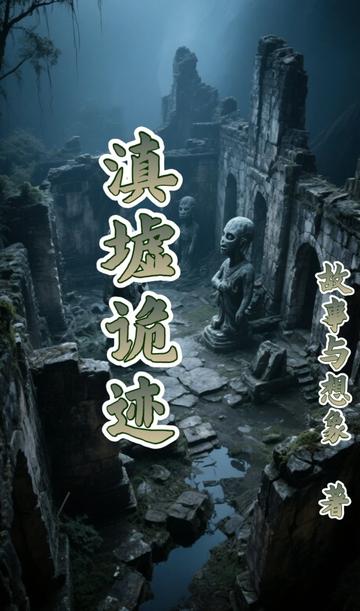
Strange Traces in the Dian Ruins
Deep in the mountains of Yunnan, a technological killing game spanning a thousand years is awakening
When retired soldier Zhao Zhenhai receives news of his grandfather’s death, an unnatural thunderstorm blankets the rainforests of southern Yunnan.
In the morgue, Zhao Jinshui’s body turns into a sheet of human skin on the autopsy table. All that remains in his abdominal cavity is half a bronze fragment, engraved with bizarre markings resembling both insects and seal script. In the bronze mirror among the ruins of the old house, the finger bones of a Ming dynasty skeleton tap out Morse code.
To uncover the curse that has claimed the lives of three generations of his family, Zhao Zhenhai follows the clues into a forbidden site of the ancient Dian Kingdom.
The archaeologist Lin Xiaoman, traveling with him, discovers that the wreckage of the “Thunder Chariot” belonging to the Ming dynasty Mu princely residence, hidden deep in the mountains, contains a mercury-vapor engine lost since the Han dynasty. The living human stakes beneath the rainforest miasma are actually biological circuits controlled by ancient craftsmen using magnets and fungal threads. And the bronze cauldron in King Xian’s tomb draws energy from the earth’s ley lines, turning human bodies into Hosts for nanoscopic magnetic insects…
Every thirty years, a magnetic anomaly triggers a catastrophe:
In 1953, an entire geological survey team went mad, and bronze fangs sprouted from the skull of its leader, Wang Zhenwu.
In 1987, the Shizhaishan archaeological team vanished without a trace, leaving behind only a melted, misshapen Luoyang shovel.
And at the bullet scar in Zhao Zhenhai’s chest, tiny magnetic beads gather to form the same strange markings found on his grandfather’s corpse
The coordinates of the ancient Dian Kingdom’s “Magnetic Palace,” and the end point of every countdown to death.