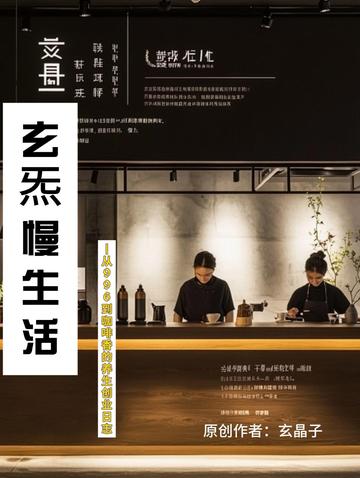
After a decade of ups and downs in the internet industry, surrounded by code and caffeine, Wang Xuandao had an epiphany one midnight while working overtime: the error messages on his screen bore a startling resemblance to passages from the Seven Slips of a Cloudy Satchel. Burdened with thirty years of mortgage payments, he resolutely mortgaged his marital home to take over an old shop in the Five Sacred Mountains Cultural and Creative Park, vowing to bring the philosophy of Daoist medicine and wellness into modern coffee culture.
From a cubicle on the 27th floor of Tengyun Tower to a curved storefront beneath a century-old ginkgo tree, Wang Xuandao followed the guidance of Gu Mingyuan, a Tai Chi master, to crack the coffee secrets hidden in a Ming dynasty tea manual: using morning dew to control the thickness of lattes, adjusting the pour-over kettle’s angle with the seasons, and turning leftover herbal medicine into fertilizer for coffee plants... When his “Five Elements pastries” came under scrutiny from food and drug inspectors, and Meituan’s system rejected his “meridian-hours business schedule,” he had no choice but to use the medicine scale left by his father to balance his ideals with reality.
Meanwhile, his wife, Su Jinghao, discovered that the buyer of their house in the county seat was actually a competitor in the cultural park. Intern Lin Suxin found data in the lab showing that astragalus coffee could fight fatigue, while Li Mo’s old fire-safety blueprints unexpectedly saved the mortise-and-tenon bar counter from imminent disaster. In this coffee shop named “Xuan,” the hiss of the espresso machine harmonizes with the sound of water boiling in a Yixing teapot, painting a warm portrait of modern city dwellers searching for a place to call home, body and soul.