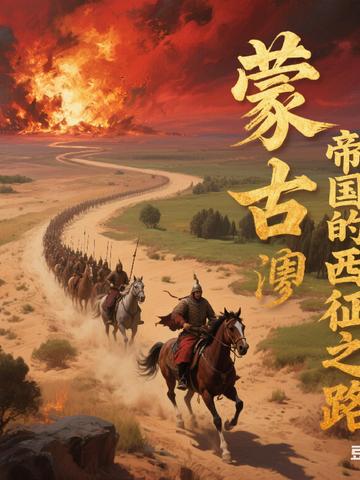
The Mongol Empire's Western Expedition: A Legend of Conquest that Reshaped the World Pattern
"The Mongol Empire's Western Expedition" uses a grand perspective and rich details to show the magnificent history of the three western expeditions of the Mongol Empire in the 13th century. These three western expeditions were not only great military conquests, but also profoundly changed the political, economic and cultural structure of Eurasia.
The first Western Expedition began in 1219. The trigger was the "Black and White Incident" in which Mongolian caravans and envoys were killed in Khwarazmo. Genghis Khan personally led the army, which was divided into four groups. Chagatai and Ogedai besieged the city of Nadara and conquered it in five months; Shuchi went down the Syr Darya River and captured many cities; Asheheinayan and others captured the upper reaches of the Syr Darya River and the Fergana area; Genghis Khan and Tolei went straight to the river to conquer the city of Nokhwara. Relying on the mobility of cavalry, the superiority of bow and arrow firepower, and siege weapons such as trebuchets, the Mongolian army captured Samarkand, the capital of Khwarezm, in 1220. King Mahamo fled and died of illness. After that, the Mongolian army continued to pursue, sweeping across the Kipchak grassland, the southern part of the Russian plain and the Ukraine, and returned to Mongolia in 1225. This western expedition expanded Mongolian power to parts of Central Asia and Eastern Europe.
The second Western Expedition, the "Eldest Son's Western Expedition", took place from 1235 to 1242. In order to expand his territory, Ogedai Khan convened a meeting of kings to decide on a western expedition, with Batu as the commander-in-chief. After the army destroyed Burial and conquered Kipchak, it marched to Orosi and defeated Moscow, Kiev and other cities. In 1241, the Mongolian army defeated the Polish-German coalition in Silesia, divided its forces into Poland and Hungary, and defeated Maza on the Sayue River.