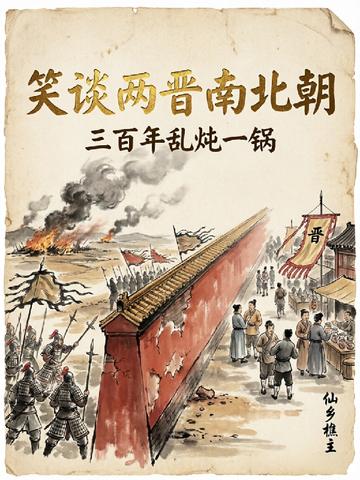
The Jin, Southern and Northern Dynasties were the most frequent periods of regime change in Chinese history. In the more than three hundred years from Wei to Sui, more than thirty dynasties, large and small, rose and fell alternately. This is a miserable and painful history, with wars and wars everywhere, and the world is merciless and human beings are treated as nothing more than dogs; this is a history of great integration of nationalities, with people traveling to the south and chatting in peace, and Beihu rising to dominance; this is also a history that has been deliberately weakened and downplayed by history books, and the madness, ugliness, and bloodiness of human nature have been exposed so vividly that it is hard to bear to look at it. But this period of history is so magnificent, full of blood, heroes, and stars...
Reader comments
This book reconstructs history in a playful way. The author attempts to use deconstruction as a scalpel to cut the war between the Jin Dynasty and the Sixteenth Kingdom into a prism of black humor, reflecting an alternative spectrum of historical narrative. The value of this book is not to retell historical facts, but to reveal the fictitiousness of all historical writing - when we use modern codes to reconstruct historical reality, aren't we using today's cultural genes to recode the historical dead? This cycle of deconstruction and reconstruction is precisely the eternal charm of literature.
Not bad, recommended!
The history is written in a humorous and humorous way without losing sharp insights. It's like friends chatting at the dinner table, telling the absurdities of emperors, generals and ministers, and the embarrassing stories of literati, in the rhythm of jokes. By making readers laugh, they understand human nature, and as they read, they can see the chess game clearly - humor is the sugar coating, and the comments are the cannonballs that explode the taste buds. They are to the point and have a long aftertaste.
Reading history is like reading a story. If you don't want to read character evaluations or Apocalypse Now, you can skip it, which is great!
This book uses joking writing to reconstruct historical articles, reflecting an alternative spectrum of historical narrative.
The history is written with humor and is not boring to read.
The writing is humorous and the language is straightforward, making it easy and stress-free to read. The enlightening content in the book cleverly fits the current reality, and it is easy for people to relate to their own lives and resonate strongly. The author's views are objective and calm, his evaluation is pertinent and measured, neither extreme nor empty. It is both interesting and thoughtful, and both readable and practical. It is an excellent book that is worth reading calmly and carefully.
It seems that the author is correcting errors, which is quite rigorous!
Detailed, interesting, and appropriate reviews can be considered pertinent. Although the stories between different characters are slightly repetitive, they just form repeated memories. I give it five stars.
This book reconstructs history in a playful way. The author attempts to use deconstruction as a scalpel to cut the war between the Jin Dynasty and the Sixteenth Kingdom into a prism of black humor, reflecting an alternative spectrum of historical narrative. The value of this book is not to retell historical facts, but to reveal the fictitiousness of all historical writing - when we use modern codes to reconstruct historical reality, aren't we using today's cultural genes to recode the historical dead? This cycle of deconstruction and reconstruction is precisely the eternal charm of literature. Not bad, recommended!
The history is written in a humorous and humorous way without losing sharp insights. It's like friends chatting at the dinner table, telling the absurdities of emperors, generals and ministers, and the embarrassing stories of literati, in the rhythm of jokes. By making readers laugh, they understand human nature, and as they read, they can see the chess game clearly - humor is the sugar coating, and the comments are the cannonballs that explode the taste buds. They are to the point and have a long aftertaste. Reading history is like reading a story. If you don't want to read character evaluations or Apocalypse Now, you can skip it, which is great!
This book uses joking writing to reconstruct historical articles, reflecting an alternative spectrum of historical narrative.
The history is written with humor and is not boring to read.
The writing is humorous and the language is straightforward, making it easy and stress-free to read. The enlightening content in the book cleverly fits the current reality, and it is easy for people to relate to their own lives and resonate strongly. The author's views are objective and calm, his evaluation is pertinent and measured, neither extreme nor empty. It is both interesting and thoughtful, and both readable and practical. It is an excellent book that is worth reading calmly and carefully. It seems that the author is correcting errors, which is quite rigorous!
Detailed, interesting, and appropriate reviews can be considered pertinent. Although the stories between different characters are slightly repetitive, they just form repeated memories. I give it five stars.