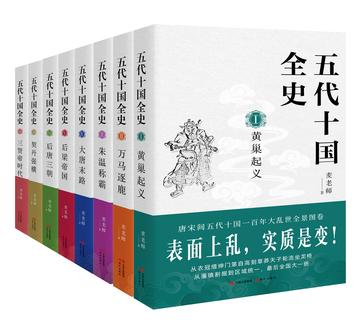
A Complete History of the Five Dynasties and Ten Kingdoms (Eight Volumes)
五代十国全史(全八册)
- Status
- Completed
- Length
- 2.2M Words
- Genre
- Historical
- Updated
- 1y ago
- Source
- Fanqie
Stats
1.2kReads
9.4Score
357Shelves
97Chapters
35.6kReads · all time
Tags
Synopsis
Reader comments
In booklists 2
Historical Novels That Travel Back to the Five Dynasties or the Northern and Southern Dynasties
Can anyone recommend novels that travel back to the Five Dynasties or the Northern and Southern Dynasties?
486.7kViews85Books4dUpdated
Historical Novels, Logical Novels
I want to watch content similar to "The End of the Yuan Dynasty Huasheng 1". All details are strictly based on real history
2.8kViews27Books11dUpdated
It is written in detail and is not boring to read. It is like a long novel. It introduces in detail the cruel history of the late Tang Dynasty and the Five Dynasties that few people know. The language is humorous and respectful of historical facts. It can be seen that the author has a deep historical accumulation and has his own opinions on many places. It is very suitable for introduction to the history of the Five Dynasties. Finished reading, worth reading
Generals of the Five Dynasties and Ten Kingdoms Later Liang: Zhu Wen (Taizu), Zhu Youzhen Zhu Youyu, Zhu Youcun, Zhu Yougong (formerly known as Li Yanwei), Zhu Youning (brother Zhu Youlun), Zhu Youliang Ge Congzhou (adopted son Xie Yanzhang), Yang Shihou, Wang Yanzhang, Wang Jingren (Wang Maozhang), Wang Zhongshi, Wang Chuzhi, Pang Shigu (Pang Cong), Niu Cunjie (Niu Li), Zhang Guiba (brothers Zhang Guihou and Zhang Guibian), Huo Cun (adopted son Huo Yanwei), Shi Shucong, Liu Wei, He Gui , He Delun (Hexi Hu), Li Hanzhi, Zhu Zhen, Li Tangbin, Li Sian, Zhang Cunjing, Kang Huaiying (formerly known as Kang Huaizhen), Xu Huaiyu (Xu Cong), Xia Luqi, Liu Zhijun, Wang Tan, Wang Yanqiu (Li Shaoqian), Hu Zhen, Wang Jingshen, Duan Ning , [Gao Jixing (Gao Jichang)], Du Tingyin, Jing Yanguang, Liu Chongba, Yuan Xiangxian, Dai Siyuan, Ding Hui, Lu Shun, Wang Qianyu, Yang Yanhong, Guo Yan, Zhang Wengong, Deng Jijun, Zhu Chongjie, Li Jitao, Li Chan, Li Chongyin, Li Hui, Li Zhouyi (Li Maoxun), Luo Shaowei (Wei Bo Jiedu), Chen Zhang, Yan Bao, Hou Yan, Bai Fengguo, Feng Xingxi, Kong Qing, Han Qing, Zhang Quanyi, Zhang Jun, Wang Zan, Dai Siyuan, Zhang Yanshou, Zhang Yuande, Gai Zhang, Lou Jingsi, Ma Sixun, Fu Daozhao, Fan Ju Shi, Hua Wenqi, Li Renfu (from Dangxiang), Ding Yanhui, Xu Renpu, Huang Wenjing, Liu Shouqi, Peng Yanzhang, Kou Yanqing, Yang Yanzhi, Yin Hao, Dong Zhang, Liu Suiyan, Yan Yong, Zhao Tingyin, Zhu Gui, Wang Du (Liu Yunlang), Li Renhan, Zhu Hanbin Later Tang/Jin: Li Cunxu (Zhuangzong, Shatuo native, father Li Keyong, uncles: Li Kening, Li Kexiu), Li Siyuan (Mingzong, Shatuo native), Li Congke Li Sizhao (Han Jintong, son Li Jitao), Li Cunxin (Uihe, formerly known as Zhang Guuluo), Li Cunjin (Sun Chongjin), Li Siben, Li Si'en (Tuyuhun native), Li Cun'en, Li Cunshen (Di, formerly known as Fu Cunshen, sons: Fu Yanchao, Fu Yanrao, Fu Yantu, Fu Yanqing, Fu Yanneng, Fu Yanlin, Fu Yanlun), Li Cunxian (Wang Xian), Li Cunzhang, Shi Jingsi (from Shatuo, formerly known as Shi Jingcun, son Shi Jiantang), Kang Junli, Li Cunxiao (An Jingsi, from Shatuo), Li Sixun, Li Sihu (from Shatuo, brother Li Sibi), Li Cunzhen, Li Jianji Guo Chongtao, Zhang Chengye (eunuch), Wang Yanqiu (Li Shaoqian), Yan Bao, Xia Luqi, Gao Siji (son Gao Xingzhou), Zhou Dewei (son Zhou Guangfu), An Jinquan (Shatuo native), An Jin Jun, Jing Yanguang, Lu Shun, Wang Chuzhi, Zhao Xingshi (Zhao Dejun, Li Shaobin), Murong Yanchao (from Tuguhun), Zhang Yanchao (from Shatuo), An Shenqi (from Shatuo, father An Jinquan), An Yuanxin, An Xiuxiu (from Shatuo), Yang Guangyuan (from Shatuo), An Chongjie (from Shatuo, father An Fuqian), Zhang Jingda, Hou Yi, Kangfu (from Shatuo), Kang Yicheng (from Shatuo) , Kang Sili, An Yanwei, Zhang Qianzhao, Sun Hanshao, Yao Yanchou (from Shatuo), Yao Yuanfu, Li Yichao (from Dangxiang, younger brother Li Yiyin), Kang Yanxiao (Li Shaochen, from Sogdiana), Zhe Congruan (from Dangxiang), Deng Jijun, Li Yuanshen, Li Junqing, Shi Yan (from Shatuo), Li Zhou (from Sogdiana), Zhang Quanyi, Ding Hui, Shi Junhe, Xue Atan, Xue Zhiqin, Huo Yanwei (named) Li Shaozhen), Shi Wanfu, He Huaibao, Li Chengsi (from Shatuo), Ma Shisu, Zhao Xingshi (Zhao Dejun, Li Shaobin), Yuan Xingqin (Li Shaorong), Liu Shouqi, Fu Xi, Zhao Renzhen, Wu Zhen, Wang Sitong, Zhu Shouyin, Fan Yanguang, Pei Yue, Zhao Tingyin, Zhu Lingde (Li Lingde), Dong Zhang, Mao Zhang, Zhang Yun, Tang Jingsi, Li Yan, Ren Wan, Yang Chongba, [Meng Zhixiang], [Shi Jingtang], [Liu Zhiyuan], He Fujin, Xingfang Ye, Li Renhan, Wang Hongzhi, Suo Zitong, Wang Sitong, Chang Congjian, An Shuqian (from Shatuo), Bai Fengjin, Bai Wenke, Zhai Zhang, Later Jin Dynasty: Shi Jingtang (Gaozu, Shatuo native), Shi Chonggui (young emperor, Shatuo native) [Liu Zhiyuan (from Shatuo)], [Guo Wei], An Congjin (from Shatuo), An Shenqi (from Shatuo), Fu Yanqing (from Di), Zhang Yanze (from Turks), Jing Yanguang, Gao Xingzhou (Zi Gao Huaide), Murong Yanchao (Tu) Guhun people), Li Jinquan (Tuyuhun people), Bai Chengfu (Tuyuhun people), Wu Luan, Li Shouzhen, An Chongrong, Fan Yanguang, Ma Quanjie, Huangfu Yu, Guo Lin, Guo Congyi (Shatuo people), Wang Yanchao, Wang Yansheng, Wu Xingde, Li Shouzhen, Yao Yuanfu, Zhe Congruan (from Dangxiang), Hou Yi, He Xianjian, Tang Jingsi, He Fujin, An Shuqian (from Shatuo), Bai Fengjin, Bai Wenke, Bai Yanyu, Yang Guangyuan (from Shatuo), Zhang Congbin, Du Chongwei, Zhai Zhang , Wang Chongyin, Cai Xingyu, Shi Gongba, Li Yiyin (from Dangxiang), Murong Ye, Du Hanhui, Zhang Congen (from Huihe), Liang Hanzhang, Li Yin, Pan Huan, Song Yanjun, Wang Qing, Wang Rao, Xue Huairang, Wang Yan (son Wang Hanlun), Later Han: Liu Zhiyuan (brothers: Liu Chong, Liu Xin) Shi Hongzhao . Tuo people), Zhao Zan, Yao Yuanfu, Zhe Congruan (from Dangxiang people), Hou Yi, Tang Jingsi, He Fujin, Liu Chongjin, Xue Huairang, Guo Congyi, Sun Fanjian (Sun Fangjian), Bai Wenke, Zhang Yanwei, Shang Hongqian, Liu Ci, Chang Si, Zhao Hui, Zhao Siwan, Li Shouzhen (Generals: Wang Jixun, Nie Zhiyu, Wei Yanlang, Zheng Bin, Zhou Guangxun), Wang Jingchong (Generals: Zhou Can, Gongsun Nian, Zhang Sirian), [Guo Wei], Li Jun (Li Rong), Wang Yan Next week: Guo Wei (Zhou Taizu), Guo Rong (Zhou Shizong) Li Chongjin, Li Jun (formerly known as Li Rong, subordinates Mu Lingjun, Wang Tinglu, and Wang Quande), Fu Yanqing (from Di, younger brother Fu Yanlin), Gao Xingzhou (son Gao Huaide), Wang Quanbin, Wang Jun, Wang Yan, Wang Jing, Wang Wangan, Li Chu Yun (son Li Jilong), Li Gu (Li Gu), Zhang Yongde, Zhang Lingduo, Han Tong, Murong Yanzhao, Wang Yansheng, Liu Tingrang, Song Xie, Cui Yanjin, Li Hanqiong, Liu Yu, Liu Ci, Guo Congyi (from Shatuo), Guo Jin, Zhao Hui (Zhao Yanjin), Tian Qinzuo, Shi Yanchao, Han Lingkun, Zhang Zangying, Wu Qianyu, Wang Yanchao, Wu Xingde, Wu Shouqi, Yang Chengxin (from Shatuo), Bai Chongzan (from Shatuo), Bai Wenke, Bai Yanyu, Kang Yanmao (from Shatuo), Guo Chong (formerly known as Guo Chongwei), Zhao Zan, Yao Yuanfu, Zhe Congruan (from Dangxiang), Hou Yi, Tang Jingsi, He Fujin, Wang Yin, Sun Fangjian (Sun Fangjian), Qiu Hongchao, Chen Sirang, Cao Wei (Cao Ying) This is the best book about the history of the Five Dynasties and Ten Kingdoms.
Only the Three Wise Emperors have not read it yet, so they can evaluate it. It is a very detailed history of the Five Dynasties. It is extremely detailed, the characters are analyzed thoroughly, and the historical prototypes deduced are also very insightful and consistent with common sense. After reading this book, the history of the Five Dynasties is enough to talk about without reading 24 Histories. There are few popular historical books on Tomato that are better than this one, and it is worth savoring.
After reading The Year of Taiping, I wanted to read more about the History of the Five Dynasties. After comparing several books, I chose to read this one. Compared with the flow and straightforwardness of other readers, this reader is more literary, and has added a certain amount of personal analysis or transcribed other historical analyses, making it more readable. Not finished reading yet, still continuing!
Only those who are knowledgeable and well-educated can write this.
The writing is beautiful and the logic is strict. Combine it with detailed historical facts and add your own analysis.
I saw it from the Three Hundred Years of the Tang Dynasty, which coincided with the Five Dynasties and Ten Kingdoms. This book is well written, keep reading.
There are very few contemporary books that are very detailed, very detailed, and objectively state the historical facts. ——_……
The writing is average but rich in details
Good looking, easy to understand language
So beautiful, great value
Detailed facts and easy to understand
The author has a lot of ink in his belly
Lively and interesting, super beautiful, recommended to everyone
Help understand the history of the Five Dynasties and Ten Kingdoms
Can have a good understanding of what happened at that time
The content is substantial and the text is lively and interesting.
The writing is good, the language is witty and humorous, and it has the flavor of the bright moon back then. It is worth reading.
It's easy to understand and makes up for this confusing historical knowledge.
The author tells history in a humorous way that is easy to understand.
The narrative style is humorous and clear. It's a good history book
The writing is witty and the historical materials are informative, worth appreciating
The writing is detailed and humorous. I have been looking for a history of the Five Dynasties and I have read a few that were not satisfactory. This one is really great.
Detailed historical data, relaxed writing style, and interesting words
Very good, written according to historical records, very exciting
Humorous, factual analysis, and unique vision!