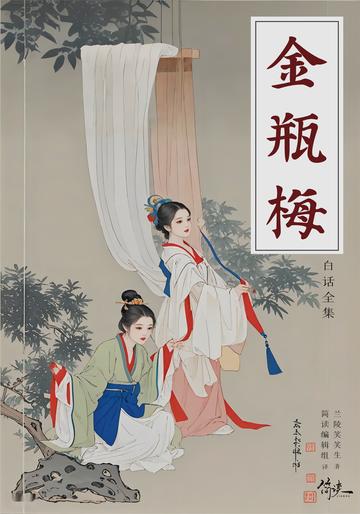
"The Plum in the Golden Vase" is the pioneer work of Chinese worldly romance novels. It is listed as the first of the "Four Wonderful Books" of the Ming Dynasty and is known as the "Scroll of Social Customs of the Late Ming Dynasty". The vernacular version launched this time reconstructs the classics in popular and fluent modern language, eliminating the barriers between classical Chinese and Chinese. The whole book takes the rise and fall of the Ximenqing family as the main line, and through meticulous descriptions of market life, vividly demonstrates the various social conditions under the boom of the commodity economy in the mid-to-late Ming Dynasty, and profoundly reveals the negotiation between commercial capital and the bureaucracy, and the game between market desires and human ethics. The work integrates rich details of social life such as business operations, officialdom rules, family ethics, medicine and health care, opera and entertainment, etc., To construct a three-dimensional and vivid ukiyo-e of the late Ming Dynasty. The book creates ground-breaking creations of complex images with profound human depth, such as Ximen Qing and Pan Jinlian. Its exquisite behavioral logic and subtle psychological activities create a new era of character creation in Chinese novels. The author Lanling Xiaoxiaosheng uses cold realism to not only show the alienation process of human nature amidst material desires, but also reveals compassion in the smoke and dust of the world. As China's first full-length novel independently created by a literati, its pioneering narrative structure and critical spirit have profoundly influenced the creation of later classics such as "A Dream of Red Mansions". The vernacular version of this book maintains the world conditions and literary essence of the original work, and through popular adaptation allows modern readers to appreciate the unique charm of this literary masterpiece without any barriers. Readers can not only feel the power of literary classics from the ups and downs of family narratives, but also touch the true texture of late Ming society through vivid historical details. This edition not only provides literature lovers with a convenient way to study classics, but also provides a vivid model for academic circles to study the social form, economic structure and human nature of ancient China. It also promotes the contemporary cultural rebirth of this once misunderstood literary treasure in a way that can be enjoyed by both refined and popular people.