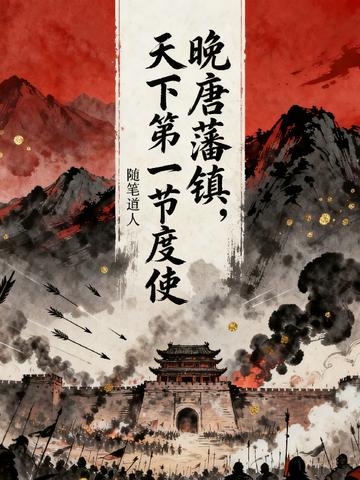
A Vassal Town in the Late Tang Dynasty, the Best Military Envoy in the World
晚唐藩镇,天下第一节度使
- Status
- Ongoing
- Length
- 3.0M Words
- Genre
- Historical
- Subgenre
- Historical & Ancient
- Audience
- Male
- Updated
- 4h ago
- Source
- Fanqie
Stats
Tags
Synopsis
Reader comments
In booklists 67
Explore more →
I Beg for Historical, Fictional, High-IQ, High-Quality Novels
As long as they are not brainless or have a supporting character whose IQ plummets, it is fine.
9.9 Points, Worth Chasing All Night Long! ! !
I want to watch content similar to "Wanwan is not Wanwan: Who still loves you after being reborn". The plot is novel and exciting, and the more you watch it, the better it gets!
Stay up All Night Reading Addictive Books
Take out all the books from the bottom of the box. All kinds of books.
The Protagonist Develops on the Frontier, Then Rebels and Expands the Territory
Power Is in the Hands of Both the Government and the Public, and the Military Power Is in Hand
Tomato Tangwen, It Should Be Number One
Good Tang Dynasty literature
Datang, Datang, Datang, Listen, It's the Voice of Datang!
If you like novels about the Tang Dynasty, you are welcome to read them and add to them.
The Ceiling of Systematic Farming Literature, If You Are Not Convinced, Come and Argue
Looking for Fictional Historical Articles, High Quality
Such as the Qin Dynasty and the Tang Dynasty
There Are No More Masterpieces in the Tang Dynasty. If You Are Not Convinced, Come and Argue! (๑╹ヮ╹๑)ノ
Heng Dao, Mo Dao, Giant Scythe, Chain Sword Qiu
Build Your Own Power at the Beginning and Grow Little by Little.
He treats his subordinates very well and is decisive in killing. They all rush to join his force.
Looking for a Time-Travel Historical Novel Like Tang Zhuan?
Looking for a time-travel historical novel like Tang Zhuan?
Are There Any Novels About the Collision of Large-Scale War Armies?
9.9 Jujuju Looks Good
I want to watch something similar to "Three Years Away". Various types
I Want It to Be Systematic, Refreshing, and Not Frustrating to Read.
Looks comfortable
Gear up and Ride Again! ! !
Please ask for heavy cavalry. I want to see it. I want to see hundreds of heavy cavalry break through thousands of troops.
Looking for High-Quality Historical War Writings
Real Officialdom Novels Should Be More Realistic and Preferably Written by People Within the System.
Just like official novels by Hou Weidong, Sun Guohua, and Wang Hongtao. Please recommend them!
Nice War Novel
The Protagonist Has a Loyal Family and Pledges His Life to the Country! but Was Framed
In Ancient Times, Those Who Served as Generals in Wars Were Purely About Force and Did Not Cultivate Immortality.
Seek History + Imaginary + War + Rebellion + High Quality + Peace in Troubled Times
It means that the protagonist performs meritorious service on the border, and then rises step by step, fights with the northern nomads, and then the world is in chaos. The protagonist brings peace to the troubled world.

The Most Promising New Book in 2026, with an Absolute Potential of 9.9 Points!
I want to see content similar to "The Battle for Hegemony in Troubled Times Begins with Summoning Xiang Yu, the Overlord of Western Chu". History, historical imagination, martial arts, martial arts imagination. It must be a new book in 2026. Those on the list are not required and will be updated in real time. The logic is online, the plot is smooth, and the fighting is exciting.
The characters are relatively fleshed-out, and the IQs of the supporting characters are also online. No matter we are friends or foes, they all have their own calculations and demands, rather than being puppets on strings. This is very good. But I don't understand why an educated time traveler needs to compete with the natives in their archery skills to get ahead? Have all the books from the protagonist's previous life been read in vain? Even before liberation, people who could write and do math were considered talents wherever they went, let alone in ancient times? The protagonist is written as a pure Aboriginal, and an illiterate Aboriginal. I can't even remember a single word of the cultural knowledge I learned in my previous life.
Chapter 321: Returning to Hometown, the writing is truly amazing. It makes me feel like I have been alive for the rest of my life. I started step by step from being a captain to a local governor, and finally became a prince fighting for hegemony in the world. In one chapter, I wrote 670,000 words of vicissitudes of life and suffering. Real success and fame. Looking back, it makes me think deeply, did I gain more or lose more?
Color! It is a high-quality and high-level historical novel. The protagonist is not a peerless warrior who leads the way and is invincible to thousands of people. In the short period of his rise, he rises from a peasant to become the governor of the latest chapter. Every step is very down-to-earth. There is no golden finger or any soap. The blockbuster old routines of ancient poems and the experience of joining the army are also very realistic, especially between soldiers. This kind of mutual restraint between superiors and subordinates really impressed me. It should be like this in ancient times. There is no real loyalty. You can give your life only by giving money and food.
This article on historical hegemony should be ranked in the top ten. Currently, there is no mention of glass, cement, high technology, lottery, or steel. It is not the kind of homogeneous historical article. Pig's feet are just ordinary people. They are not hung up and developed step by step. It is very consistent with the historical era and there is nothing unreasonable. Recommended by a twenty-year-old bookworm.
It's a rare good book. It's not a brainless novel. The protagonist doesn't have a golden finger. He passively goes with the flow in troubled times, making every step startling. The constant trade-off between reality and ideals, constantly gambling on the future. It's really good. At least, it's very realistic, instead of still living in a dream in troubled times. [Like][Like][Like][Like][Like] Forget it, I took back the five stars. Only later did I realize that the protagonist's ability to govern the country and lead troops is about the same as that of Zhao Song's group, mediocre.
It's well written. There is no obvious cliché plot, nor is there a catering plot. I will get what I want instead of waiting for the pie to fall from the sky... The characters have a deep structure of human nature, and it ranks among the top five historical novels I have read.
Very good, the writing is very interesting. The strategy should be to sweep across the north and unify the grassland tribes, become the next Liao Kingdom, and then spy on the Central Plains [Thinking] The progress was too fast at the beginning, and suddenly it became Youzhou Jiedu. Everything else was fine. I look forward to the author's update [Learned]
Wonderful! The protagonist Chen Congjin rises from the wilderness, dares to fight and fight, is not a virgin, and has his own plans for future development. The author can shape the protagonist well! The plot is also quite good. From the current point of view, this is a rare novel about hegemony in the late Tang Dynasty! The author is advised to update as soon as possible! ! !
A good novel should be like a bright mirror, reflecting the wrinkles of the times and the glimmer of human nature. This book falls into this category. His diction is concise but warm, and a few strokes can outline vivid scenes, such as "When the old locust trees in the alley are snowing, the copper bell on the candy seller's pick always wakes up before the smoke from the cooking stove." It makes readers feel like they are immersed in the scene, and the text is full of imagery and appeal. The plot design is even more ingenious. The main plot is advanced at a leisurely pace, and the branch plots are interspersed just right. There is no redundancy or procrastination, and there are hidden foreshadowings everywhere, such as the old letters collected by the protagonist, which are unremarkable when they first appear, and then reveal the mystery of their life experience in the later stages. The progressive layers make the story more profound. The most touching thing is its profound description of human nature. There is no absolute distinction between good and evil characters. The villain's struggle and the protagonist's hesitation are all written in a real and tangible way, allowing readers to think about the relationship between themselves and the world while following the ups and downs of the plot. Such a textured and in-depth work is worth reading carefully.
It's very beautiful, very consistent with the history of Fanzhen in the Tang Dynasty, and very immersive, especially the chapter about returning home, which can be said to be directly deified. Although the protagonist is a time traveler, he can perfectly integrate into this world. He has both the wisdom of modern people and the thinking of ancient people. There is no contradiction. Everything about Dashuai was worked out step by step, and it can be said that it was perfectly in line with the real life at that time. The protagonist is still relatively virgin in the early stage, but I think that is a normal phenomenon, and modern people's thinking still has a great influence. After all, at that time, the protagonist did not completely substitute himself into the era of the late Tang Dynasty. The protagonist had to grow up step by step. Later, after fully substituting himself into the era of the late Tang Dynasty, he could be said to be a fully qualified commander, and he might later become a qualified hero or emperor.
This is a very good article on the subject of the late Tang Dynasty. An ordinary person, without cheats, gradually started to develop with a little understanding of the general trend. Now he is already divided into one party, and he has a good grasp of the rhythm.
The more you read, the better it gets. This book is a slow-burning book with no big poisonous points. It is very interesting to read. Moreover, it does not directly develop technological gunpowder or anything like that. It is a direct push. Instead, it conquers the world step by step. Moreover, the author has a good grasp of history.
The novel is rigorous and the content structure is very well laid out. The author has a good foundation in reading the whole text. The content tends to be realistic. It is not an airplane or a cannon. It is the magic pen of the Creator, not the handwriting of an ordinary person. The foreshadowing of this book can be said to be above 9.5. It is interesting to read.
It's quite good, and there's nothing sinister about it. It's rare to see novels written between the end of the Tang Dynasty and the Five Dynasties and Ten Kingdoms. I guess there are relatively few historical records of such novels. They're not the familiar novels about the Three Kingdoms, the early Tang Dynasty, or the late Ming Dynasty. There aren't many people who can write them. Come on, keep working hard, and I hope it will be interesting.
I am very lucky to have read this book, and thank the author for his writing. The Taiping Year was recently broadcast, and many people complained that they could not understand the timeline clearly. I feel very lucky. I have followed it all the way to the present. Through the author's wonderful writing, I am more interested in understanding the grandeur and historical background of the late Tang Dynasty. From a God's perspective, I know that the real history is depressing ( The emperor, the Sixteen States of Yanyun, the rise of foreign races, the ending of the Song Dynasty, etc.) Are always full of regrets, and the author's Chen Congjin is more like a dream master, mending regrets, and predictably leading China into a more perfect history. Although it is a bit cool, every Chinese has a vision of a strong nation. I like the perfect ending, who cares. This is my first time writing a book review, and I don't know if I'm going to write it here. I don't know how to write a paragraph review or a chapter review. Finally, come on, author, your writing is great! ! ! ! ! Awesome (broken sound)! ! ! ! !
The plot is steady and steady, and the protagonist slowly grows up. It feels really good. The author's historical skills and writing style are very online. It is very good among the historical texts of the late Tang Dynasty. It is a good book worth reading! Recommend!
Apart from anything else, this book has a very well-controlled pacing. Although most of the plot is about court and war, you won't feel bored while reading it. Several plot climaxes are well written and impressive. The biggest highlight of this book is that after the middle period, it reduces the focus on generals and instead focuses on generals. This is not only in line with common sense, but also creates a group of generals with distinctive and colorful personalities. This allows the book to remain dynamic in the middle and later periods and will not make readers feel the same and boring. Now this book has reached the final stage. In fact, I feel that there is still more to write. There is no need to end it too hastily. So far, the plot is still very exciting, especially the Battle of Bohai, which brought Guo and Zhao to life. Maybe the story of the commander is over, but I can continue to write the stories of the courtiers, generals, soldiers and common people. Their lives are equally exciting.
After reading this book, my evaluation is that it is second only to "The Floating Life of the Late Tang Dynasty" by Lonely Maike, the master of starting points, among late Tang novels, and it can be said to be outstanding among tomato novels. First of all, the writing is very realistic and detailed, and the restoration of the late Tang Dynasty is very good, making people feel very immersed; Secondly, the pace is appropriate and not too fast; Moreover, the writing style is not trivial, and it has achieved a good balance between historical authenticity and readability; In addition, the protagonist is more three-dimensional and has a distinct personality; Overall, this book is incomparable among tomato novels and historical texts of the late Tang Dynasty. (By the way, I recommend "Floating Life in the Late Tang Dynasty". Long live Shao Sheng Shao Shude!)
The writing is very good. Compared with the first part, the writing style has been greatly optimized. I've known it for a long time since I was in the fifth generation, so it's really great to see such a time-travel novel written in combination with the historical facts I know. It can be said to be the best among the five generations of time travel novels currently available.
At the end of the Tang Dynasty, there were many vassal towns. It was you who sang and I came on stage, and the king's flag was changed on the city wall. Those who rebel and dominate are like the crucian carp crossing the river. The Tang Dynasty declined, conquests continued throughout the world, chaos reigned, and rituals and music collapsed. In such a chaotic situation, the author wrote it in an orderly manner, first and last. It cannot be achieved without years of hard work. This book is truly excellent! Hope to update soon
The author listened to the advice very much and corrected the parts that everyone thought were inappropriate in the way of Zhi Shui. So far, the writing is pretty good and there are not too many bad points. Cheers to the author, I hope more book lovers who are interested in the late Tang Dynasty and Five Dynasties can read this novel and support its continuous updating.
Traditional historical hegemony essay The advantage is that the protagonist, including the supporting roles, as well as Li Keyong, Swine Fever, Tian Lingzi, etc., Are still very full of images. The writing style is also good, and the battlefield rendering is also good. It is not a wave of famous generals, nor a brainless victory, but a temple calculation, battle preparation, psychology, and political warfare. The disadvantage is that it over-strengthens the enemy. In check, Sichuan was given to Li Keyong, which weakened most of the Central Plains and then strengthened the swine fever If this book can end with 1000 chapters, I think it will be good. If it exceeds 1000, it will be too delayed. The protagonist's advantage is already very great. It was okay in the early stage, but around March 22, 2026, the author wanted fans to give him a country name, a bunch of understanding brothers, Qi Yu or Xia. The author was still considering these two, whether they were suitable or not. I knew this novel was useless. At least the author's historical reserves are not sufficient to write serious historical novels. He didn't understand that the country's name was not made up out of thin air, but based on the protagonist's life. You have to first understand how the ancients (at least before the Song Dynasty) determined the name of the country. One sentence explanation 1. Commemorating the merits and virtues of our ancestors is the name of the country. 2. People of this generation are granted the title of king and nobility and use the title of king as the title of their country. 3. The location of one's own territory and government corresponds to the Spring and Autumn Period and the Warring States Period, corresponding to the country's name. 4. Consider yourself the successor of a certain person, occupy the territory of your ancestors, and use the name of your country as the name of your country. Yu (doubtful) Xia, Shang and Zhou Qi Chu Yan Han Zhao Wei (Jin) Qin Han (with the king as the country) Han, Wei, Wu Jin One Cheng and one summer, two Zhaos and three Qin, four Yans and five Liangs Northern Wei, Eastern Wei, Western Wei, Northern Qi, Northern Zhou Song Qi Liang Chen, Huan Chu, Hou Han Sui Tang Song Is there an escape from this set? Song Dynasty and later Liao is a country in the Khitan language "". Gold conquers iron, using gold as the country Neo-Confucianism (which originated from the Book of Changes) arose in the Song Dynasty, so when people read the books, the Yuan Dynasty came from the Book of Changes The same is true for the Ming Dynasty. The Yi Jing came and succeeded the Yuan Dynasty. At the same time, they did not recognize Wu and denied that they were subordinates of the Longfeng regime. Qing, that is, Jin, is the phonetic close sound of Jin in Manchu. Jin inherited the Kingdom of Jin and is the source of No. 4.
It is really in line with the actual situation of ordinary people. There is no system or earth-shattering invention. It is just the struggle experience of an ordinary person at the bottom. It is interesting, logical and makes people want to read on. (The free prostitute party gives the author a thumbs up) [I learned it] [laughing evilly]
The overall story is pretty good, the plot is not too procrastinating, and the rationality is okay. It can be seen that the author has spent time researching. The writing is basically up to standard, and at least it can be read fluently. However, the language expression is not good and the sense of substitution is insufficient. However, in Tomato, being able to write fluently is considered very good. Generally speaking, it can be read in the late Tang Dynasty. If you like the same genre, you can also read "The Floating Life of the Late Tang Dynasty" (the same period as this book) and "Elegy of the Prosperous Tang Dynasty" (this is before and after the Anshi Rebellion). In addition, Wei Zhangjing's "The Festival of the World" (the timeline is about 20 to 30 years later than the book) and "The Song of Colorful Iron Clothes" (the period of Emperor Gaozong of the Tang Dynasty) are also quite good, as long as you can tolerate his little poisonous point of worshiping foreigners.
I, an old bookworm, can't stand other historical novels, but I did read this one. Overall, it's enjoyable enough and it can fill the gap of excellent Tomato novels in this historical period. I still highly recommend it.
I have read many historical novels, and I have to say that the author is very thoughtful in this one. The design is in line with historical facts. It can be seen that he has truly studied and understood the history of the Five Dynasties and the Tang Dynasty. At the same time, for military writing, you can see that the author has studied military books. The development of the novel follows the background of the times, and it is real and immersive. Highly recommended! ! !
I very much agree with book friend Wei Junjie. The biggest problem with this book is that there is absolutely no trace of modern people in the protagonist. It is called time travel, but he has no modern perspectives, insights and abilities. But the writing is fluent, and it can be considered a staple in historical texts. After all, most historical texts can't even tell simple stories clearly.
As I continue to read, the novel has allowed me to understand the characters of that historical period. The characters are well-characterized and impressive. They are not literate or pretentious. There are no women who can't walk. The reading experience is smooth. I can also understand the style of the late Tang Dynasty and relieve the troubles of the Five Dynasties, Ten Kingdoms and Song Dynasty. I wish the author will get better and better as he writes and finish the book soon! In addition: It would be more satisfying if, as a time traveler, you could leave some kindling in culture and technology, so that the people in this book's future time and space would suffer less. [Laughing]
It is very realistic, and the absurdity of the late Tang Dynasty is vividly expressed in the following plot. It is not the rhythm of a traditional cool novel. Every step taken by the protagonist is a choice of the current situation. It is truly developing a team, rather than just one person constantly coming up with strategies or novel creations. Real historical changes may be like this, slowly and geographically, rather than becoming a trend or gaining recognition all at once. Time is always a very important factor.
I've been following it, it's a relatively rigorous book, and it's good to read. Just giving some suggestions. In the later period, the conquest of Annan and the pacification of the Western Regions can be written, but the battle against Japanese pirates is not suitable, and it is a bit divorced from reality. After reading this, I feel that the settings in the book are still very close to reality. The eastward journey to Japan feels a bit dramatic, and the words written in the text are very strange. I suggest putting it in an extra chapter, and I hope the author will give it some serious consideration. Thank you @essay Taoist