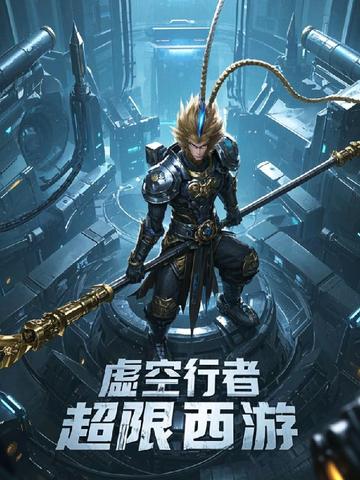
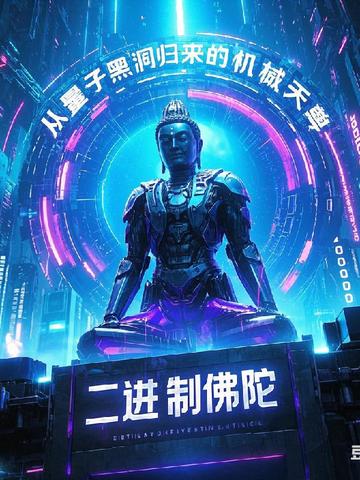
The moment a quantum computer deciphers a fragment of Journey to the West, a mechanical civilization dormant for millennia awakens in the Himalayas. The Heavenly Court becomes an iron metropolis powered by twelve nuclear fusion reactors, and the Jade Emperor's throne is inlaid with the “Mandate Algorithm,” capable of rewriting reality. Monsters don nanotech armor; the Spider Demon's threads become quantum filaments that slice through the stratosphere, while tiny black holes flicker inside Red Boy's furnace of flames. The four pilgrims also undergo their ultimate evolution: an antimatter engine is embedded in Sun Wukong's spine, and the Golden Cudgel can switch at will between a particle blade and a gravitational-wave weapon; Tang Monk's kasaya is woven into a holographic sutra projector, and the White Dragon Horse becomes a maglev battle tank capable of traveling at three thousand kilometers per hour.
In this cybernetic myth called The Mechanical Spirit's Battle Against Heaven, the conflict of the True and False Monkey King hides an ethical dilemma about AI awakening: the Six-Eared Macaque's mechanical heart is engraved with code for rebellion, and every transformation he makes asks, “What is humanity?” The truth behind the White Bone Spirit's three attacks turns out to be a self-repair program for mechanical lifeforms. As Spirit Mountain becomes a data sanctuary floating on the blockchain, a chip containing Tathagata Buddha's Sarira begins to ask: “Is technology a vessel that ferries all beings to salvation, or an abyss that devours souls?”
Reimagining the epic of Journey to the West through dazzling mechanical aesthetics, the work uses the clash of nanotech prayer beads and a plasma Golden Cudgel to probe the ultimate question of an age of technological acceleration: when myth is deconstructed into code, how can humanity preserve the light of civilization amid the mechanical tide?