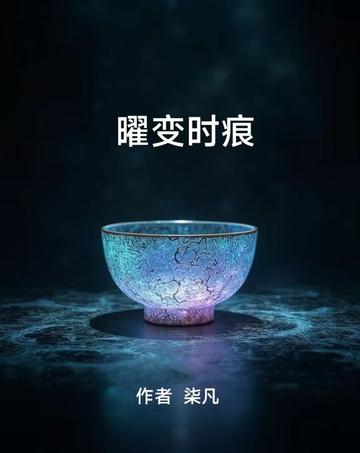
When the cold droplets beading on the kingfisher-feather inlay of a Wanli phoenix crown reflect a countdown to her father's death, Shen Tang, a Palace Museum conservator, is forced into a quantum predicament spanning seven centuries.
In a near future torn apart by the torrents of technology and the skills of tradition, blockchain-certified antique trading, neuroarchaeology pods that carry memory proteins, and enamel-based pathological technology capable of rewriting historical dates draw Shen Tang into a Möbius-like trap in time and space. The Suzhou numeral-code cipher left behind in her father's lab, the Warring States bronze circuitry exposed inside Zhou Yanchuan's mechanical arm, the Yuan-dynasty blue-and-white porcelain patterns growing over Lin Manshu's collarbone: all the clues point to the Nine Cauldrons server buried deep beneath Chengguang Auction House. Through its metaverse auction hall, human civilization is being carved up into slices of time and space for sale to the highest bidder.
From the kiln fires of the Jingkang Incident to a blood pact at a pawnshop in 1937, from a bloodstained star chart on a bronze armillary sphere to the embryos of civilization gestating in quantum wombs, the conservators gradually discover that every artifact is a key capable of altering time and space, and every restoration triggers the observer paradox. When the mortise-and-tenon patterns of the Yingzao Fashi emerge in Shen Tang's DNA, and Zhou Yanchuan's consciousness is forged into a blockchain scaffold of torture, they must choose before the bronze nebula collapses: become the genetic progenitors of a new civilization, or remain eternal sinners in the folds of spacetime.
Blending artifact-tech punk with quantum lyricism, this story weaves the purple mottling of Jun ware with the blue glow of blockchain as it asks the cruelest question about civilization's survival: Is restoration an act of salvation for history, or the original sin of altering time?