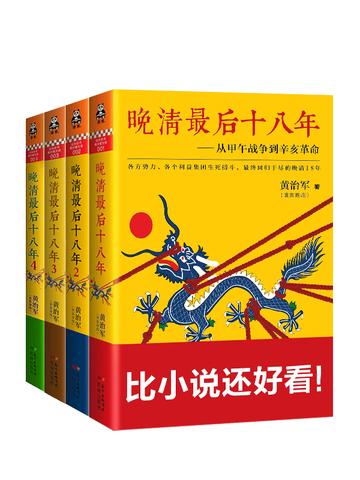
Reform is a consensus, the biggest benefit cake of the late Qing Dynasty, and it is also a duel ground for factional politics. Whether it is the Empress Dowager Cixi, the royalists, the Manchu dignitaries, or the pro-Western forces and the Boxer Rebellion, everyone is involved in it and takes turns to appear. In the end, the Eight-Power Allied Forces came to Beijing under the guise of protecting the embassy. The turbulent and chaotic situation of the Qing Dynasty was finally reshuffled, with some people being eliminated and others taking over. When the reform finally had to be pushed onto the fast track, the Manchu royal family and the powerful Yuan Shikai launched a desperate struggle for the leadership of the reform. With a gunshot in Wuchang City, the revolutionaries stepped into the center of power shouting exciting slogans. A new round of intricate overt and covert struggles between Yuan Shikai, Song Jiaoren and Sun Yat-sen kicked off... Behind the seemingly absurd and strange historical events, there is an extremely clear choice of interests and power game.
Reader comments
From the Sino-Japanese War of 1894 to the Eight-Nation Allied Forces' invasion of China, and then to the Russo-Japanese War, in the book, I saw the treacherous history and an era of weakness and disastrous defeat. The real characters in the book have predicted everything that happened in that era. They will eventually become history and become an indelible mark in Chinese history. Finally, the rolling wheels kept moving forward. The fall of the Qing Dynasty and the outbreak of the Revolution of 1911 finally cleared the clouds and ushered in a new era and light. —Read it on September 3, 2025
How should I put it? The late Qing Dynasty described by the author is very different from the late Qing Dynasty told us by history textbooks. However, through this book, I can understand that period of history more deeply. Because history has always been multifaceted, when we look at history, we cannot stay in a certain stereotype.
This is one of the best books about history that I have ever read. After reading it, I was deeply moved. History is a long river, and magnificent things are happening every minute and second. But for us, the most important thing is just the present, at this moment.
The writing is good, the story is wonderful, and the tension is exciting. It solves the doubts about the textbook when I was studying in middle school. This book is very popular, even if it is told to children, it will not be boring, and the combination of narrative and discussion is still very reasonable.
After reading this book, people are reminded of that period of humiliating history. We should learn from history and continue to grow. Thanks to the strength of the motherland, if you fall behind you will be beaten! Only when a nation becomes strong can a country be prosperous and strong. A weak country has no diplomacy. We need a continuously strong motherland at all times, otherwise all diplomacy will be the diplomacy of a weak country without any say!
The Qing Dynasty was closed to the outside world, condescending to the outside world, and lacked autonomy, which eventually led to the decline of its national power. The decline of the Qing Dynasty seems to be a historical necessity. It is sad to read and full of emotions.
The four books start with Yuan Yuan and end with Yuan Yuan. The author's thinking and entry points are very profound. Yuan's helplessness is a helplessness that Chinese people of that era can deeply sympathize with after 100 years. I really like the author's description of the final chapter.
I used to think that history books were very boring, but this book completely changed my mind! The last eighteen years of the late Qing Dynasty were simply more ruthless than a palace drama - big shots were vying for power, reforms became a cover for factional fighting, the Sino-Japanese War of 1895-1991 was a disastrous defeat, and the Revolution of 1911 was shocking every step of the way. The author breaks down the complex political strategies in plain language, which made me slap my thighs: It turns out that internal fighting can really destroy a country, and falling behind is destined to be beaten! This history of blood and tears is like a mirror, reflecting the value of unity and self-reliance. Every Chinese should read it!
Let's take a look at the history from the late Qing Dynasty to modern times. Not many people write history seriously and beautifully. This is the kind of book that is rare. Collect it and use it as extracurricular reading for babies in the future.
Behind the few words in the history books, there are such twists and turns and bizarre stories of events and characters. I feel more and more that history requires careful reading to understand all kinds of human affairs, accidents, social situations, the development of things, and the evolution of laws... There is really too much to understand.
It is not simply a translation of history books, but also adds the author's understanding of the history of the late Qing Dynasty, which is more enlightening. It's no worse than what happened in the Ming Dynasty. Well-founded and interesting, a very solid set of books.
What really moved me was not this book, but the author. At the end, the author talked about the writing process of this book. It was very moving and touching. It made me understand what is really important and what is the miracle of mindfulness.
Reading history will give you insights, but this period of history always makes people worried. No matter how good the works are, it cannot change it. So let us learn the lessons of history, not repeat the same mistakes, and build a strong country with a strong and prosperous people.
That period is not easy to describe because the historical data are not complete and many issues such as the Guangxu and Song Dynasty cases are inconclusive. However, the author's historical spirit is rigorous and he gives his thoughts and judgments as objectively as possible. Recommended
History is not easy to write, but once it is written it is very unforgettable
I re-understood the history of the late Qing Dynasty when various forces competed with each other. Real history is by no means black and white. Like the author of Those Things in the Ming Dynasty, I hope there are more history books like this.
This book made me get to know many people and things again. Li Hongzhang, Cixi, Guangxu, Kang Youwei... All kinds of experiences, processes and hardships... Reading this book has been a baptism for my heart and cognition, making me realize the cruel history.
The last eighteen years of the late Qing Dynasty were intertwined with weakness and turmoil, as well as passion and hope. The last page of feudalism was torn off, and a new era began to sprout from the pain. What a wonderful presentation, it made my heart ache and my blood boil.
After reading four volumes, I personally feel that the overall quality is very high. After describing the historical facts, it analyzes doubtful events and the logic is also very rigorous. There are many trends in the world. If you follow it, you will prosper, and if you go against it, you will perish. This sentence really resonates
Each class is trying to turn the tide, but they all have their own limitations. Standing today, we will certainly find the decadent old dreams ridiculous. We should learn from the lessons of history, rather than mocking everyone in history from a superior perspective.
History books can always make people feel the insignificance of human beings in the context of the times, benefit a lot from them, and reshape the view of modern history.
I have a relatively complete understanding of this complicated history, and it is indeed better than the novel! Regardless of historical knowledge or reading experience, this is a set of books definitely worth reading more!
It gave me a relatively comprehensive understanding of the characters in the late Qing Dynasty. The book three-dimensionally displayed the personalities of different characters, and carefully analyzed the thoughts and motivations behind various behaviors. It was completely logical and gave me a natural sense of identification with the author. Of course, this book is not a research report. The author expresses his own thoughts on everything, and there seems to be some references to the past to satirize the present. This is also the charm of this book.
It is easy to understand and easy to get started. After reading it, read the official history for easier understanding. The whole story from the Sino-Japanese War of 1891 to the Revolution of 1911 is clear at a glance. People who have walked through the historical stage always feel that they have regrets and limitations. Even if they count the famous figures, they still look at China after its awakening.
The author's preface is also very touching. I didn't expect the writing process to be so tortuous. This is the best popular history I have read after "Those Things in the Ming Dynasty", which will give readers a different understanding of the late Qing Dynasty.
After listening to this book, I feel like I have traveled back in time.
The author visited on-site during the writing process and verified it with multiple sources of information, which is considered relatively credible. Readability is also relatively high.
After reading it, my understanding of the history of the late Qing Dynasty became more three-dimensional and intuitive. For me, a science student, this book is quite interesting and opened my door to history.
There is a huge amount of information. As you read and check it, you can think about it. Can historical people and events be viewed as right or wrong? The more I read, the more interesting it becomes. History is more exciting than novels.
After reading it, I have a new understanding of the views of historical figures. I am currently studying management courses, and it is very rewarding to compare the courses with history.
History is always so similar and heart-wrenching. After reading it, I have become disenchanted with these historical figures. The only thing that will never change is the greedy heart.
From the Sino-Japanese War of 1894 to the Eight-Nation Allied Forces' invasion of China, and then to the Russo-Japanese War, in the book, I saw the treacherous history and an era of weakness and disastrous defeat. The real characters in the book have predicted everything that happened in that era. They will eventually become history and become an indelible mark in Chinese history. Finally, the rolling wheels kept moving forward. The fall of the Qing Dynasty and the outbreak of the Revolution of 1911 finally cleared the clouds and ushered in a new era and light. —Read it on September 3, 2025
How should I put it? The late Qing Dynasty described by the author is very different from the late Qing Dynasty told us by history textbooks. However, through this book, I can understand that period of history more deeply. Because history has always been multifaceted, when we look at history, we cannot stay in a certain stereotype.
This is one of the best books about history that I have ever read. After reading it, I was deeply moved. History is a long river, and magnificent things are happening every minute and second. But for us, the most important thing is just the present, at this moment.
The writing is good, the story is wonderful, and the tension is exciting. It solves the doubts about the textbook when I was studying in middle school. This book is very popular, even if it is told to children, it will not be boring, and the combination of narrative and discussion is still very reasonable.
After reading this book, people are reminded of that period of humiliating history. We should learn from history and continue to grow. Thanks to the strength of the motherland, if you fall behind you will be beaten! Only when a nation becomes strong can a country be prosperous and strong. A weak country has no diplomacy. We need a continuously strong motherland at all times, otherwise all diplomacy will be the diplomacy of a weak country without any say!
The Qing Dynasty was closed to the outside world, condescending to the outside world, and lacked autonomy, which eventually led to the decline of its national power. The decline of the Qing Dynasty seems to be a historical necessity. It is sad to read and full of emotions.
The four books start with Yuan Yuan and end with Yuan Yuan. The author's thinking and entry points are very profound. Yuan's helplessness is a helplessness that Chinese people of that era can deeply sympathize with after 100 years. I really like the author's description of the final chapter.
I used to think that history books were very boring, but this book completely changed my mind! The last eighteen years of the late Qing Dynasty were simply more ruthless than a palace drama - big shots were vying for power, reforms became a cover for factional fighting, the Sino-Japanese War of 1895-1991 was a disastrous defeat, and the Revolution of 1911 was shocking every step of the way. The author breaks down the complex political strategies in plain language, which made me slap my thighs: It turns out that internal fighting can really destroy a country, and falling behind is destined to be beaten! This history of blood and tears is like a mirror, reflecting the value of unity and self-reliance. Every Chinese should read it!
Let's take a look at the history from the late Qing Dynasty to modern times. Not many people write history seriously and beautifully. This is the kind of book that is rare. Collect it and use it as extracurricular reading for babies in the future.
Behind the few words in the history books, there are such twists and turns and bizarre stories of events and characters. I feel more and more that history requires careful reading to understand all kinds of human affairs, accidents, social situations, the development of things, and the evolution of laws... There is really too much to understand.
It is not simply a translation of history books, but also adds the author's understanding of the history of the late Qing Dynasty, which is more enlightening. It's no worse than what happened in the Ming Dynasty. Well-founded and interesting, a very solid set of books.
What really moved me was not this book, but the author. At the end, the author talked about the writing process of this book. It was very moving and touching. It made me understand what is really important and what is the miracle of mindfulness.
Reading history will give you insights, but this period of history always makes people worried. No matter how good the works are, it cannot change it. So let us learn the lessons of history, not repeat the same mistakes, and build a strong country with a strong and prosperous people.
That period is not easy to describe because the historical data are not complete and many issues such as the Guangxu and Song Dynasty cases are inconclusive. However, the author's historical spirit is rigorous and he gives his thoughts and judgments as objectively as possible. Recommended History is not easy to write, but once it is written it is very unforgettable
I re-understood the history of the late Qing Dynasty when various forces competed with each other. Real history is by no means black and white. Like the author of Those Things in the Ming Dynasty, I hope there are more history books like this.
This book made me get to know many people and things again. Li Hongzhang, Cixi, Guangxu, Kang Youwei... All kinds of experiences, processes and hardships... Reading this book has been a baptism for my heart and cognition, making me realize the cruel history.
The last eighteen years of the late Qing Dynasty were intertwined with weakness and turmoil, as well as passion and hope. The last page of feudalism was torn off, and a new era began to sprout from the pain. What a wonderful presentation, it made my heart ache and my blood boil.
After reading four volumes, I personally feel that the overall quality is very high. After describing the historical facts, it analyzes doubtful events and the logic is also very rigorous. There are many trends in the world. If you follow it, you will prosper, and if you go against it, you will perish. This sentence really resonates
Each class is trying to turn the tide, but they all have their own limitations. Standing today, we will certainly find the decadent old dreams ridiculous. We should learn from the lessons of history, rather than mocking everyone in history from a superior perspective.
History books can always make people feel the insignificance of human beings in the context of the times, benefit a lot from them, and reshape the view of modern history.
I have a relatively complete understanding of this complicated history, and it is indeed better than the novel! Regardless of historical knowledge or reading experience, this is a set of books definitely worth reading more!
It gave me a relatively comprehensive understanding of the characters in the late Qing Dynasty. The book three-dimensionally displayed the personalities of different characters, and carefully analyzed the thoughts and motivations behind various behaviors. It was completely logical and gave me a natural sense of identification with the author. Of course, this book is not a research report. The author expresses his own thoughts on everything, and there seems to be some references to the past to satirize the present. This is also the charm of this book.
It is easy to understand and easy to get started. After reading it, read the official history for easier understanding. The whole story from the Sino-Japanese War of 1891 to the Revolution of 1911 is clear at a glance. People who have walked through the historical stage always feel that they have regrets and limitations. Even if they count the famous figures, they still look at China after its awakening.
The author's preface is also very touching. I didn't expect the writing process to be so tortuous. This is the best popular history I have read after "Those Things in the Ming Dynasty", which will give readers a different understanding of the late Qing Dynasty.
After listening to this book, I feel like I have traveled back in time.
The author visited on-site during the writing process and verified it with multiple sources of information, which is considered relatively credible. Readability is also relatively high.
After reading it, my understanding of the history of the late Qing Dynasty became more three-dimensional and intuitive. For me, a science student, this book is quite interesting and opened my door to history.
There is a huge amount of information. As you read and check it, you can think about it. Can historical people and events be viewed as right or wrong? The more I read, the more interesting it becomes. History is more exciting than novels.
After reading it, I have a new understanding of the views of historical figures. I am currently studying management courses, and it is very rewarding to compare the courses with history.
History is always so similar and heart-wrenching. After reading it, I have become disenchanted with these historical figures. The only thing that will never change is the greedy heart.