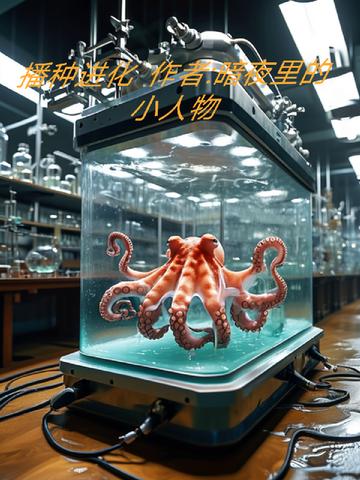
Lin Yuan stood in the vast laboratory, surrounded by an array of precision instruments and equipment. They ran in orderly fashion, humming softly, like harmonious notes in a symphony of scientific exploration. At that moment, all his attention was fixed on the incubation chamber before him. Inside was Test Subject No. 1274, a giant Pacific octopus that carried months of his team's research hopes and concealed unknown risks.
Lin Yuan's protective gloves had somehow become soaked with culture fluid. The dampness made his hands uncomfortable, but he paid it no heed, keeping his eyes fixed on the data constantly changing on the monitoring screen. When he saw that the subject had entered the third stage of genetic recombination, his brow furrowed slightly, and an unusual feeling rose in his heart. It was like a hidden current stirring beneath a calm lake. There were no visible ripples yet, but an air of danger seemed to be quietly spreading.
The octopus's tentacles, originally gray-blue, were now steadily secreting a phosphorus-silicon compound. The substance seemed almost alive as it slowly seeped from tiny pores in the tentacles, then quickly solidified on the skin. A moment later, patterns resembling integrated circuits began spreading across its surface. At first there were only a few scattered flecks, but in the blink of an eye they grew like evil vines, crisscrossing until the entire body of the octopus was covered in those eerie patterns.