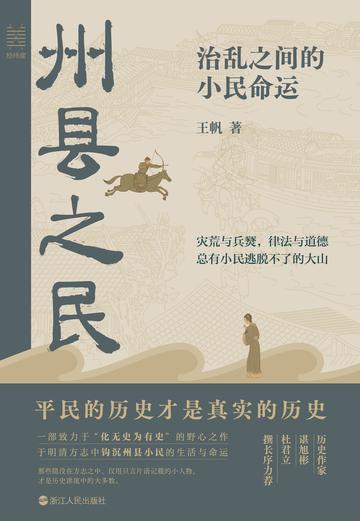
Disasters and wars, laws and morals, there are always mountains that ordinary people cannot escape. An ambitious work dedicated to "turning history into history". The chronicles of the Ming and Qing dynasties describe the lives and fate of ordinary people in Shenzhou County, and are highly recommended by historical writers Chen Xubin and Du Junli in their long prefaces.
The history of the common people is the real history - the gentle representatives of the students, the wealthy gentry and merchants, the hardworking people, the chaste women and martyrs... Those little people who are hidden in the local chronicles and recorded only in a few words are the majority in the torrent of history.
Almost all official histories feature emperors and generals as the protagonists. Affected by this, today's historical research works mostly focus on the rise and fall of dynasties, court struggles, and famous generals. The civilian population, which occupies an overwhelming number, is often presented only as a backdrop.
Through careful reading of the local chronicles of the Ming and Qing Dynasties, as well as the crawling of imperial edicts, memorials, notes, family trees, inscriptions and other documents, this book salvaged only a few words of records hidden in the documents, and gave a hearty group portrait of the people of the prefectures and counties.
This book takes the Xiqi land in the Guanzhong area as the main research object, mainly the "Qishan County Chronicles" and other local chronicles of Xifu during the Qianlong period, and other documents and archives of the Ming and Qing Dynasties. It starts with typical figures in the prefectures and counties, including the gentle representatives of the students, the wealthy gentry and merchants, the hard-working Qi people, the chaste women and martyrs... Through the analysis of their lives and destiny, it attempts to restore the living conditions of ordinary civilians in the prefectures and counties during the monarchy.
Reader comments
I recommend everyone to read this book. Not only did I see the lives of ordinary Chinese people in ancient times, but I also understood why no matter how prosperous the feudal empire was, the people would always have so much suffering. The prosperous age is the prosperous age of the emperor and never belongs to the common people.
This is a very good book that looks at all the living beings at the bottom during the period of chaos and chaos from the late Ming Dynasty to the late Qing Dynasty and the Republic of China from the perspective of ordinary people. For the common people, the imperial court is too high and the governors and governors are too far away. What they can know is probably the daily life below the county level.
I've only read a few thousand words, and this is the beginning of the story. A good book, a rare good book. In this era, few people like to read this kind of books anymore.
Very detailed information
Ordinary People's History
To be honest, this book is a bit boring, haha, but it gives me a new understanding of the ancient social structure.
Leave a claw.
In fact, most people know most of the theories mentioned, but this book provides support through county annals.
A must-read book for the common people, especially the interpretation of the Twenty-Four Filial Piety.
A rare novel that reflects the lives of ordinary people at the bottom of society in history!
This book is really good, I really like this style









I recommend everyone to read this book. Not only did I see the lives of ordinary Chinese people in ancient times, but I also understood why no matter how prosperous the feudal empire was, the people would always have so much suffering. The prosperous age is the prosperous age of the emperor and never belongs to the common people.
This is a very good book that looks at all the living beings at the bottom during the period of chaos and chaos from the late Ming Dynasty to the late Qing Dynasty and the Republic of China from the perspective of ordinary people. For the common people, the imperial court is too high and the governors and governors are too far away. What they can know is probably the daily life below the county level.
I've only read a few thousand words, and this is the beginning of the story. A good book, a rare good book. In this era, few people like to read this kind of books anymore.
Very detailed information
Ordinary People's History
To be honest, this book is a bit boring, haha, but it gives me a new understanding of the ancient social structure.
Leave a claw. In fact, most people know most of the theories mentioned, but this book provides support through county annals.
A must-read book for the common people, especially the interpretation of the Twenty-Four Filial Piety.
A rare novel that reflects the lives of ordinary people at the bottom of society in history!
This book is really good, I really like this style