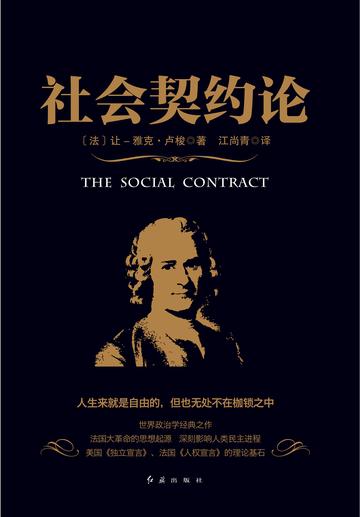
This book discusses issues such as state and people, state and law, freedom and equality, state and society. Rousseau mainly discusses the relationship between social structure and social contract, sovereignty and its rights, government and its operating forms, etc. In the book, Rousseau also discusses the composition of several social organizations and their advantages and disadvantages. In "The Social Contract", Rousseau described what his ideal country would look like. He believed that people are born free and equal. An ideal society should be based on the contractual relationship between people, and the country should be the product of free agreement.
Reader comments
This book had a profound influence on the civilizational system of later generations, but there were several places that were not explained clearly and had logical loopholes. Rousseau saw the opposition between the rich and the poor, but he attributed the wealth accumulation of the rich mostly to the encroachment of "first enclosure" or the fraud of the social contract, and failed to delve into its sustainability. The economic production process, but the reality is that any accumulation and maintenance of wealth beyond individual survival must rely on the reproduction process of other people's living labor input. His attempt to "reset" rights relations at the political level lacks an effective explanation for the economic cycle on which wealth depends.
Rousseau's community requires individual will to be fully integrated into the "general will," which is economically equivalent to a planning system that attempts to unify production and distribution on behalf of everyone. However, because the theory ignores the specificity of production activities and the dispersion of knowledge, its "general will" will inevitably fall into inefficiency and chaos in economic practice, or it will spawn a bureaucrat with information collection and coercive power to act on its behalf.
In a society where labor and capital are differentiated and dependent, control over the means of production and employment relationships will inevitably and continuously be transformed into political influence and social dominance. Rousseau hoped that through a contract, the rich would voluntarily give up their privileges and integrate into an equal citizen group, which ignored the dependence of power on its material foundation.
Secondly, since the "general will" itself is abstract and cannot be perfectly represented by any specific institution, who is to judge what the general will is? In reality, this provides an absolute reason for groups or individuals who claim to represent the "true general will" to suppress dissidents and implement "forced freedom" in the name of noble morality.
Social division of labor and interest differentiation: Modern society is based on a complex division of labor. People have different and sometimes conflicting specific interests due to their different occupations, skills, and positions in the industrial chain. An engineer and a farmer definitely have different understandings of welfare.
From a psychological point of view, Rousseau held a view of human nature based on the theory of historical degeneration, believing that lonely individuals in the state of nature are self-sufficient, peaceful, and compassionate. It is private ownership and social interaction that give rise to competition, vanity, and exploitation. Therefore, his political plan has a strong color of "moral restoration" and "transformation of human nature," trying to return people to or achieve some kind of pure citizen virtue through perfect institutional design.
However, this left a model for all social systems in later generations.
After reading it, I was amazed that Rousseau had such a vision in that era! However, Rousseau said in the article that his self-contradiction was because he could not find a suitable language to express it, and then said that mediocre people may not be able to understand advanced language, which made me feel a little funny [laughing and crying] [laughing and crying] [laughing and crying]. Generally speaking, this book may have a relatively high threshold for reading. It involves many analogies related to other subjects, such as the proportional middle term in mathematics. At first glance, it is really hard to understand without thinking carefully. In fact, some of the theories he talked about may not be particularly profound, but the language feels a bit obscure, making it a little tiring to read (it may also be a problem with my own understanding). After reading it once, I felt that I didn't fully understand the essence of the book. I will come back and read it again when I have time! The academic value of this book is quite high and it is worth reading.
2025-12-02 Completed. 5⭐️ 9.6 Points. Well deserved, a classic will always be a classic. Some chapters that seem to have nothing to do with ordinary people, but if you read them carefully, you will find that the whole book is connected with our lives, lives, experiences, choices, and expectations. This classic runs through the entire life, forming a unique picture of our own. This is a good book for repairing, changing, and shaping three views. Good tea is not to be drank in one go, but tasted again and again. The essence needs to be understood, digested and absorbed by oneself. Highly recommended!



This book had a profound influence on the civilizational system of later generations, but there were several places that were not explained clearly and had logical loopholes. Rousseau saw the opposition between the rich and the poor, but he attributed the wealth accumulation of the rich mostly to the encroachment of "first enclosure" or the fraud of the social contract, and failed to delve into its sustainability. The economic production process, but the reality is that any accumulation and maintenance of wealth beyond individual survival must rely on the reproduction process of other people's living labor input. His attempt to "reset" rights relations at the political level lacks an effective explanation for the economic cycle on which wealth depends. Rousseau's community requires individual will to be fully integrated into the "general will," which is economically equivalent to a planning system that attempts to unify production and distribution on behalf of everyone. However, because the theory ignores the specificity of production activities and the dispersion of knowledge, its "general will" will inevitably fall into inefficiency and chaos in economic practice, or it will spawn a bureaucrat with information collection and coercive power to act on its behalf. In a society where labor and capital are differentiated and dependent, control over the means of production and employment relationships will inevitably and continuously be transformed into political influence and social dominance. Rousseau hoped that through a contract, the rich would voluntarily give up their privileges and integrate into an equal citizen group, which ignored the dependence of power on its material foundation. Secondly, since the "general will" itself is abstract and cannot be perfectly represented by any specific institution, who is to judge what the general will is? In reality, this provides an absolute reason for groups or individuals who claim to represent the "true general will" to suppress dissidents and implement "forced freedom" in the name of noble morality. Social division of labor and interest differentiation: Modern society is based on a complex division of labor. People have different and sometimes conflicting specific interests due to their different occupations, skills, and positions in the industrial chain. An engineer and a farmer definitely have different understandings of welfare. From a psychological point of view, Rousseau held a view of human nature based on the theory of historical degeneration, believing that lonely individuals in the state of nature are self-sufficient, peaceful, and compassionate. It is private ownership and social interaction that give rise to competition, vanity, and exploitation. Therefore, his political plan has a strong color of "moral restoration" and "transformation of human nature," trying to return people to or achieve some kind of pure citizen virtue through perfect institutional design. However, this left a model for all social systems in later generations.
After reading it, I was amazed that Rousseau had such a vision in that era! However, Rousseau said in the article that his self-contradiction was because he could not find a suitable language to express it, and then said that mediocre people may not be able to understand advanced language, which made me feel a little funny [laughing and crying] [laughing and crying] [laughing and crying]. Generally speaking, this book may have a relatively high threshold for reading. It involves many analogies related to other subjects, such as the proportional middle term in mathematics. At first glance, it is really hard to understand without thinking carefully. In fact, some of the theories he talked about may not be particularly profound, but the language feels a bit obscure, making it a little tiring to read (it may also be a problem with my own understanding). After reading it once, I felt that I didn't fully understand the essence of the book. I will come back and read it again when I have time! The academic value of this book is quite high and it is worth reading.
2025-12-02 Completed. 5⭐️ 9.6 Points. Well deserved, a classic will always be a classic. Some chapters that seem to have nothing to do with ordinary people, but if you read them carefully, you will find that the whole book is connected with our lives, lives, experiences, choices, and expectations. This classic runs through the entire life, forming a unique picture of our own. This is a good book for repairing, changing, and shaping three views. Good tea is not to be drank in one go, but tasted again and again. The essence needs to be understood, digested and absorbed by oneself. Highly recommended!
Very beautiful, very powerful
Okay, finally finished reading it