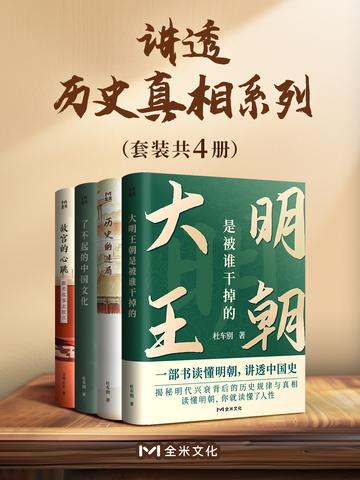
"Who Killed the Ming Dynasty" is a historical work that deeply explores the reasons for the demise of the Ming Dynasty. Starting from the financial and military crisis in the late Ming Dynasty, the author explores the underlying reasons for the demise of the Ming Dynasty through detailed historical data analysis and logical reasoning. The book challenges the prejudices of traditional historiography and re-examines the history of the Ming Dynasty, including the myth of Chongzhen's internal money, exaggerated corruption, and the truth about excessive expropriation.
The core of this book is to reveal the problems of the advanced development of ancient China's political system and the premature control of political power by the bourgeoisie. These problems resulted in the country's inability to transform a developed social economy into strong national power, and ultimately led to the tragic end of the Ming Dynasty. Through reorganizing historical facts and in-depth theoretical analysis, the author refuted the theory of stagnation of Chinese history and demonstrated the richness and complexity of ancient Chinese history.
The book also explores three common attitudes toward Confucianism in contemporary academic circles, criticizing the views of complete denial, partial affirmation, and attachment to Western neoliberalism, and points out that these attitudes reflect China's ideological inferiority since modern times.
In addition, this book uses the Forbidden City as the background and travels through the time tunnel to tell the story of the glory and vicissitudes of Chinese civilization witnessed by the Forbidden City from 1420 to 1925. Through detailed analysis in seven chapters, the author explores whether there really was a phenomenon of "emphasis on agriculture over commerce" in ancient China, Weber's views on the origin of capitalism, the explanation of the economic foundation in traditional Chinese theory, the rationality of the concept of feudal society and its application to the nature of ancient Chinese society, the emergence of capitalism in the Song and Ming dynasties, and many other aspects.
Reader comments
Historical commentary is objective and pertinent
The viewpoint is unique and the historical data is informative. The Ming Dynasty was indeed hacked hard!
The logic is clear and the information is detailed.
The Ming and Qing dynasties are worth knowing about for Chinese people.



Historical commentary is objective and pertinent
The viewpoint is unique and the historical data is informative. The Ming Dynasty was indeed hacked hard!
The logic is clear and the information is detailed.
The Ming and Qing dynasties are worth knowing about for Chinese people.
It can be perfect, fine, fine
Well-founded and informative historical data.