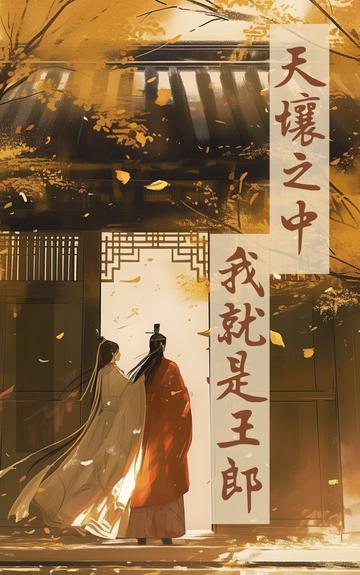
天壤之中,我就是王郎
- Status
- Completed
- Length
- 1.4M Words
- Genre
- Historical
- Subgenre
- Historical & Ancient
- Updated
- 10mo ago
- Source
- Fanqie
Synopsis
Other names
- Usurping Jin: Wang Ningzhi's Rise from the Ashes篡晋,王凝之的逆袭人生Former title · until Oct 2026
More by this author
In booklists 199
Explore more →
Fifteen Years as a Veteran Reader, and My Taste Has Gotten Picky
Finished Novels That Leave You Awestruck and Linger in Your Mind
Completed novels that are stunning to the core and linger in your mind long after you finish them.
Looking for Masterpieces, but Not Anything on the Recommendation Rankings
Don't recommend anything where the protagonist's surname is Ye or Ling, where the protagonist has a cute little sister, or where the protagonist is a bleeding-heart do-gooder. In short, no stupid novels. The darker and more ruthless, the better! Kill, kill, kill!!!
Historical Fiction! The Characters Must Have Brains!!
Are there stories where a modern person transmigrates back to ancient times and uses their profession to make a difference? Like a doctor who transmigrates to the past and advances medicine within the limits of the era, or a modern special forces expert who transmigrates to ancient times and builds an army using modern ideas. Or just invent penicillin or something. From the start, they pull out an AK-47.
Please Recommend High-Quality Historical or Alternate-History Novels with Highly Intelligent Characters
Anything is fine as long as it isn't brainless and the supporting characters don't suddenly lose all their intelligence.
High-Quality, Highly Rated Reads Only, No Amateurish Writing. I've Read All the Famous Ones.
Looking for stories similar to Taking the Name Langya. Male- or female-oriented is fine, preferably historical, imperial examination, or fantasy. No System and no ridiculously overpowered golden fingers. For female-oriented stories, no simpering, stupid heroines.
The Best Historical Novel on Fanqie Right Now. Prove Me Wrong
I want books similar to The Matter of the Southern Dynasty's Noble Son Actually Being Someone I Impersonated.
Looking for High-Quality Historical Fiction. No Mindless Power Trips or Brain-Dead Plotting
I want high-quality historical fiction that’s engaging and doesn’t dumb things down or rely on brainless plots. It can be satisfying, but don’t treat readers like idiots. No stories like the one where the protagonist fools Cao Cao’s quartermaster about the provisions from the start, or those where a literati protagonist suddenly has the strength of a tyrant. They’re unoriginal and mindless...
A Passionate Story About the Protagonist Becoming a General, but Not Becoming Invincible
Nothing where the protagonist is invincible right from the start. I want something more realistic and passionate.
Tomato’s All-Time Masterpieces
Looking for books like I'm Not the God of Theater. One of the greatest novel series of all time. Recommend, recommend, recommend!
Historical Stories (Any Dynasty, No System, and with Intelligent Characters)
Looking for books like "The Glory of the Great Wei". Historical novels with some brains behind them. Read too many mindless wish-fulfillment stories and they’ll rot your mind.
Looking for Meticulously Researched Historical Fiction
They seem pretty hard to find. Let's give it a try.
Novels These Days Are Too Rushed. Hardly Anyone Takes Their Time and Writes Carefully
Don't make me look at any of Tomato's five toxic genres!
Looking for Historical Novels Set in Ancient Times, With a Male Protagonist. A Normal Number of Wives and Concubines Is Fine
Are There Really No Good Novels for Male Readers Anymore?! Don’t Make Me Switch to Female-Targeted Novels!
Looking for books similar to "Slay the Gods".
Looking for Rigorous, High-Quality Historical Fiction Like A Borrowed Surname in Langya
Looking for stories like "The Matter of the Southern Dynasties' Noble Young Master Being an Impostor".
What’s the Hottest Historical Novel on Tomato Novel?
I’m in a reading slump.
Any High-Quality Historical War Novels Like Shao Song?
War! I Want War! Massive Wars, and the Protagonist Has to Be a Monster
The Best Historical Novels From Every Dynasty
Preferably a book rated above 9.
Fully Armored Heavy Cavalry!!!
Please recommend heavy cavalry. I want to see hundreds of heavily armored horsemen smashing through an army of thousands.
Historical Fiction That Feels Realistic
No System, and nothing about The Legend of Qin. Just straight historical fiction.
High-IQ Alternate-History Novels
I want something with intelligent characters. No stories that rub my nose in how stupid I am, even if I’m not exactly a genius.
Looking for Stories About Campaigning, Rising Through the Ranks From the Bottom, and the Age of Cold Weapons
I'm looking for books like Tang Yin in Another World.
Reader comments 50
Translated by Google Translate
The Eastern Jin Dynasty is an era that is difficult to comment on, and we have met a good author. He can write about the sick celebrities, the insurmountable sects, and the regrets of the era. The protagonist, King Langya, was born and did not ask for the power of the imperial examination in the Song and Ming Dynasties. Unification is a success, and the power of a unified court can be tapped. I look forward to the author. I have finished reading the latest chapter. The defense of the Luoyang Central Plains is very well written. It describes the war in the entire Central Plains in great detail. It is hard to believe that it is just a small battle. Compared with other cool articles about the battle, it is quite interesting.
A relatively good-looking historical article about the Northern and Southern Dynasties, which allows the protagonist to solve problems from the perspective of people of that era. There is no necessary scientific knowledge for time travelers, only knowledge applicable to that era. This article is really very sophisticated about history (it feels like quoting classics). The characters and stories are rich, and the article written has a kind of It feels like reading a classical Chinese article (contains spoilers), but in the early stage of the article, there are some descriptions of the grassroots, but in the middle and later stages, it breaks away from the description of the market, and only writes about the protagonist's strategies and chess against that class and the clan. It seems to lack the description of his subordinates, the common people, and the market, but Maybe the main theme of that era was like this. It was an era where powerful families and aristocratic families controlled the government and the opposition. It was an era where ordinary people could not succeed in their lives. But how can history be considered complete without ordinary people? In the middle and late period (from Chapter 240 onwards), there are less and less descriptions of details. This game is It is just a game between the top people, lacking the charm of small people and the survival of the common people. Like many historical articles, it tends to be straightforward in the later stages and blindly advance the story line. But in Tomato, it is a really good article. I still want to give it 5 stars, but I still want to say that I like this work very much and hope that its shortcomings can be pointed out.
It's a good book, but if you like to read exciting articles, it's better to quit it as soon as possible. Seeing this so far, I have witnessed the protagonist growing up from ignorance and wishful thinking through time travel, experiencing many setbacks and gradually giving up on his fantasy. The book does not include the clichéd time-travel plot of making gunpowder and various technologies to crush the opponent, but writes wars and games in great detail. It's not easy for the author. I personally think it's very good and worth reading.
It's a good read. It's a serious and serious historical article. I like the interaction between the young couple the most. It's very sweet and real. If the author writes that Wang Ningzhi treats Xie Daoyun badly in the future, it will be like a thunder from heaven. I hope it will be maintained.
Tomato is one of the rare real historical articles, which is very comfortable to read. Only people who really like history will know what I mean. In fact, the talents of one county are enough to rule the world. People are animals shaped by their environment. No one is a hero at the beginning. There are some things that need to be tempered. There is no need to criticize the author's portrayal of the protagonist. The real history is sometimes a bit regretful and helpless. That's why we lament that Wei Wu whipped his whip and broke his halberd at Red Cliff, Huan Wen went on the Northern Expedition and stationed his horse in Chang'an, sent slaves to live there, and stopped dreaming of the Central Plains. That's why more and more people are writing to help these heroes realize their dreams. Who will ever mention Mo Yun Brush and create a beautiful chapter with passion? I wish the author will stick to it and write better and better.
It is suitable for elegant romance and strategic history. It has a sense of the times that combines the Wei, Jin and Northern Song Dynasties. There are many sensational plots, but it is different from the kind of literary style that strives for hegemony and unification. The writing is very good, but it lacks the sense of historical heroes.
The writing is comfortable and has a historical charm, just like a cup of good tea, which requires patience to savor.
The ending of Murong Ke was rewritten. Huan Wen's exit, and He Wu's (a small character created in the book) sacrifice and memorial. So well written. The end of the life of the ancient beloved is written more beautifully, but without losing logic. The inner anatomy of the dialogue between Huan Wen, a traditional historical bad guy, and the protagonist when he exits the scene reveals the extraordinary character of this character. The coolness and self-control of this man who can say that he will be infamous for eternity even after death and that Wang Dun is a Kerr. Even if a little person is like a reed in troubled times, he will be shattered into pieces after encountering the light of Dao, and he will not be afraid. There are many other well-written places as well. For example, a book friend recommended War, but I don't know much about it, so I won't say more about it. After reading these three, if you are interested, you can read more about this book. It is simply the gold among tomatoes!
What can I say, this book is very interesting to me. Let's talk about the trivial shortcomings first. The character descriptions are relatively flat and not full enough, especially for some of the generals around Wang Ningzhi. I feel that there is no sense of vicissitudes of gradual growth from youth to middle age, as if their abilities are always at a peak. Moreover, the force is too strong, but after all, it is a magic book catalogue, so it is normal. Then the advantages are more obvious. The rare and valuable point is that the narrative rhythm is not chaotic, it is very comfortable to watch, and it does not appear to be fragmented because of the description of different characters and plots. The language is concise, and there is a sense of comfort like eating fresh food. The dialogue between the characters is very interesting, and Wang Ningzhi's changes in personality as his seniority increases are reasonable, but he still has an innocent heart. The author gave history a completely different development, and it was reasonable, not boring, and not overly embellished. It was very good. In some aspects, it captured my mind better than Mao Surnamed Langya.
It's worth reading, and the author keeps writing. Every chapter is exciting to read! The author's research on the history of the Eastern Jin Dynasty is simply amazing. The morning bells and evening drums in Jiankang City, the power battles at the banquets of aristocratic families, and even the costumes and etiquette of the nobles' children are all vivid, as if they really brought us back to the era of gold and iron horses. The protagonist's step-by-step growth path after traveling through time is so exciting. From being plotted when he first entered the court, to uniting with people with lofty ideals to form a new army, every crisis reversal is amazing! Especially the battle of wits when dealing with Huan Wen, as well as the battle on the Northern Expedition where fewer people defeated more, the plots are so intertwined that people can't stop watching. What is even more rare is the creation of group portraits in the book. Whether it is a counselor who has the world in mind, or a heroine who is not inferior to men, every character has flesh and blood. I sincerely hope that Da Da Da can continue to maintain this rhythm. I can't wait to see how the protagonist rewrites the Battle of Feishui and leads the Eastern Jin army to reorganize the mountains and rivers!