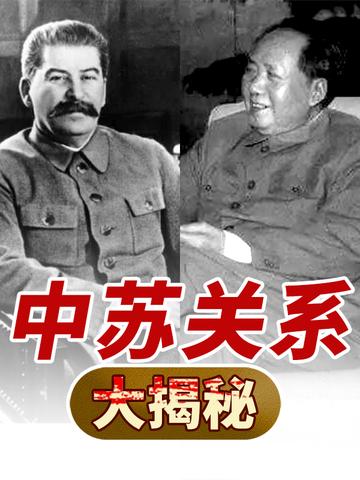
Since the Second World War, the relationship between China and the Soviet Union has shifted from a friendly alliance to debate, confrontation, and then to normalization diplomacy!
A complete record of the major events between China and the Soviet Union. This album takes you back to that turbulent era and unearths the truth behind history.
Part One: The inside story of Khrushchev's visit to China and the deterioration of Sino-Soviet relations
In February 1956, the 20th National Congress of the Communist Party of the Soviet Union opened. Khrushchev came to power, completely negated Stalin, and planned to use force to attack Poland. The atmosphere in Warsaw was very tense. Chairman Mao was severely critical of Khrushchev, saying that the Soviet Union's use of troops was serious great-power chauvinism. At this point, Khrushchev harbored a grudge against China, and the "honeymoon period" of Sino-Soviet relations gradually dimmed.
Part Two: The Secret History of the Deterioration of Relations between China and the Soviet Union
On October 1, 1959, the 10th anniversary celebration of the founding of the People's Republic of China was held grandly in Tiananmen Square, Beijing. While watching the celebrations on the Tiananmen Gate Tower, Khrushchev suddenly said to Chairman Mao: "Concerning the production of atomic bombs, we have decided to withdraw the experts." At this point, serious differences occurred between China and the Soviet Union.
Part Three: Sino-Soviet Border Negotiation Contest
In February 1964, China and the Soviet Union began talks in an extremely unfriendly atmosphere, and eventually the talks broke up. Tensions on the Sino-Soviet border greatly increased after 1966
Part 4: Decryption of the Zhenbao Island Self-Defense War
On March 2, 1969, the Soviet Union openly invaded the Zhenbao Island area of Chinese territory, and our army was forced to fight back. At this point, the Zhenbao Island War broke out between China and the Soviet Union.
ISBN: 9787546318332
Reader comments
It's a very good book. I hope I can continue to record and broadcast it. Although not many people read it, it is a precious spiritual wealth for history and individuals. The modern way of learning knowledge is gradually changing from reading to listening. This is a trend. These precious past historical experiences, lessons and records must also follow this trend to be universally understood by more people.
It's a very good book. I hope I can continue to record and broadcast it. Although not many people read it, it is a precious spiritual wealth for history and individuals. The modern way of learning knowledge is gradually changing from reading to listening. This is a trend. These precious past historical experiences, lessons and records must also follow this trend to be universally understood by more people.