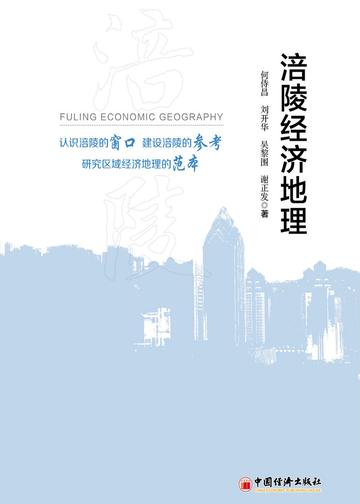
"Economic Geography of Fuling" consists of ten chapters. The first chapter is an introduction, clarifying the research object, significance, main content and methods. The second chapter is the historical evolution and economic division of Fuling, clarifying the historical evolution of Fuling's administrative division, economic geography, and strategic position. The third chapter is about natural geographical resources, analyzing the status, characteristics and economic value of Fuling's natural resources from the aspects of Fuling's geology and mineral resources, topography, climate, rivers, soil, vegetation, ecological environment, etc. Chapter 4 is about humanistic and social resources, analyzing the status and characteristics of Fuling's humanistic and social resources from the aspects of social culture, population, infrastructure, market economic foundation, policy environment, etc. Chapter 5 is the economic geography of the primary industry. On the basis of clarifying the production conditions of Fuling's primary industry, it focuses on analyzing the production and layout of planting, forestry, animal husbandry, fishery and other industries. The sixth chapter is the economic geography of the secondary industry. After sorting out the endowment conditions of Fuling's secondary industry, it focuses on analyzing the production and layout of chemical fiber, food and medicine, important materials, equipment manufacturing, electronic information, clean energy, construction and other industries. Chapter 7 is the economic geography of the tertiary industry. After clarifying the resource conditions of Fuling's tertiary industry, it focuses on analyzing the production and layout of commerce, foreign economy, finance, tourism, transportation and logistics, public services, producer services and other industries. Chapter 8 is the characteristic economic geography. After summarizing the characteristic economic geography of Fuling, it focuses on the production and layout of industries such as mustard, rouge radish, and fermented glutinous rice. Chapter 9 is urban economic geography, analyzing the formation, development and layout of Fuling's urban system. Chapter 10 is about the optimization of Fuling's economic and geographical layout. On the basis of clarifying the economic and geographical characteristics of Fuling and its objective requirements for economic and geographical layout, it reveals the existing problems in Fuling's economic and geographical layout and proposes the optimal development direction. These ten chapters are both self-contained and interrelated, forming a complete system of Fuling's economic geography.