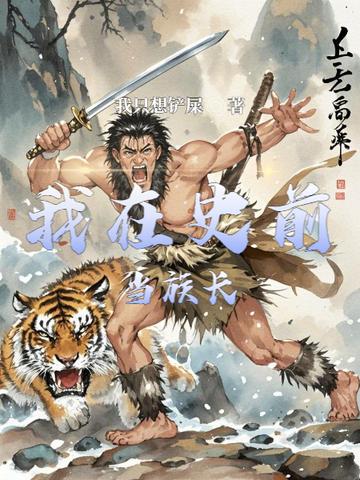
I Was a Patriarch in Prehistory
我在史前当族长
- Status
- Ongoing
- Length
- 4.3M Words
- Genre
- Historical
- Subgenre
- Historical & Ancient
- Audience
- Male
- Updated
- 6h ago
- Source
- Fanqie
Stats
Tags
Synopsis
Reader comments
In booklists 54
Explore more →
Farming+pasture+farm+fishing System+system Farm+space
+

Please Write Real Farming Articles, Don't Use the Guise of Farming Articles to Not Even Plant a Single Grain.
A Fascinating Book About Establishing a Private Power or a Fiefdom Lord in a Low-Key Manner.

In Farming Articles, Don't Treat People to Dinner with Wild Boars and Rabbits Without Braised Pork.
I would like to read a book like "The whole village gnawed tree bark in the lean years, but I have a system to fill the warehouse with meat".

A Book Like Robinson Crusoe About the Development of Farming from Scratch


Travel to Ancient Times and Build a Modern City
Have you traveled back in time to ancient times and used modern technology to build a city?


Ancient Times, Small Countries, Construction, Development, Secret Development Novels, Chinese and Western
Time travel, ancient construction

Looking for Farming, House Renovation, Lingquan Wine Making, Leisure
Don't pretend to be poor, don't slap someone in the face, don't lead the whole village to get rich, don't open a zoo! Plant top-grade flowers and plants, grow top-grade herbs, and build an ornamental fish pond! You can do live broadcast!


A Novel That Travels Back to Primitive Society and Leads Primitive People to Develop Civilization.
The protagonist leads the primitive people to develop civilization. There is no fantasy power.

A Collection of Construction, Survival, Management and Novels.
All types of novels are accepted, whether the pig's feet are birds, animals or monsters, I can accept them.
Looking for Articles on Land Reclamation, Farming, Mining, Developing and Building Cities?

The Best Novel About Wild Tribes
Everyone recommends your favorite tribal novels


Tribe, Farming, Development, Welcome to Buy! ! !
Travel back to the primitive tribe, develop the tribe from farming, and achieve unification step by step. (The system flow can be bypassed, cheating is still acceptable as long as it is not too exaggerated)

Purely Tribal, Not Systematic. Strong Recommendation
A novel without a system may be dull due to lack of exaggeration, but it will definitely be enjoyable to read.
A Novel That Seeks to Be Reborn into a Primitive Tribe and Lead Its Development
Those who are more normal don't want Mythology, those from World of Warcraft, just farm and smelt iron for production.
Are There Any Farming Articles Focusing on Breeding and Farming?
To be finished

A More Realistic Farming Story, a Pure Farming Story
It's not an exaggeration or a lack of common sense! For example, if you can plant thousands of acres of fertile land yourself, how many square meters will it take?


Looking for Infrastructure Construction Articles from Scratch
Like to read infrastructure articles
Traveling Through Primitive Tribes, There Is a System to Develop and Unify Small Tribes



Great Wilderness, Wild Wilderness, Ancient Times, Ancient Times
Traveling through ancient times, magic, magical power system



Farming, a Large Area of Food, Backing, Is There Anyone Who Serves the Country?


Come! Hit Me with a Stick
I want to read a book similar to "The Foolish Plays of the Gods". I'm tired of watching it in ten days, the drama god has finished watching it, the god of death has passed, and Tomato has no more masterpieces.
The Original Text Includes Totem Warriors and Witches
Are there any original novels?
I think the cost-effectiveness of raising deer is relatively low, unlike cattle, sheep and pigs. I also think that wolves can be domesticated, and dogs can be used in many ways. Hunting, guarding, herding, etc. It can even be used as a backup ingredient! And dogs eat what humans eat, you don't need to raise a lot of them, it's totally fine.
The pace is fast and I feel like every chapter is very busy. The writing is good and very careful, but it is too detailed and feels a bit watery. There is no mess like intrigues and intrigues. It is still very interesting to focus on development. Reading too many war novels makes me tired. Each chapter has three to four thousand words and is very comfortable to read. It is recommended to add some short stories occasionally. Taking out a lot of things at once is a bit boring. The book is very interesting and worth recommending when you are in a book shortage.
It's okay, the pure construction flow is the ancient joint model of cooperation, and it should be jointly founded in the future [laughter] There is currently no sign of war, which is a bit boring for a war freak like me (I want to see rivers of blood [laughs]) Summary: If you like management and construction, you can take a look
It looks okay, but the pace is a bit too fast. It takes less than 2 years to build a house, build a wall, make pottery, weave, blacksmith, dry meat and fish, open up land for farming, domesticate so many poultry and livestock, provide them with fodder for the winter, and hunt, and everything is basically done simultaneously.
There are currently 90 chapters. Although there are some minor bugs, the flaws are not concealed. The overall flow is very smooth and it is a pure ancient farming story without any weird magic or fantasy. The surrounding tribes have almost started to get used to farming together, and then they can start to formulate a calendar. The calendar is the core of agriculture, politics, and culture. Agriculture: Calendars can calculate when to plant crops, and when to start storing grain for the winter; Politics: If the surrounding tribes obey you just because you bring new items, greed and betrayal will easily occur. If the calendar is established, there will be faith, and belief in this law of planting life, then the law makers are equivalent to their rulers; Culture: For tribes further away, they can also open up markets through commodities, and then use the calendar to stipulate them, and they will have the same way of life, the same customs, and the same culture. With this foundation of rule, we can concentrate our efforts on doing big things [shy] (In ancient my country, there are records that the establishment of calendars was unique to the rulers)
Come on, be logical and self-consistent, and keep people from getting out of the plot. You can describe the features of the primitive prehistoric continent, novel things, and bold imagination, as long as the logic is self-consistent and combined with some prehistoric archeology and modern things. The use of modern things keeps the good habit of checking.
Not bad but there are some questions. Do even primitive people really not know how to fight? I don't believe it. It's normal for different tribes to have conflicts and fights. Also, the author wrote that there should have been other prehistoric prehistoric races during this period, but there were a few, but only late-stage Homo sapiens remained. I don't need to tell you why. You can also write a little about this. I hope the author can consider these later.
Why didn't you build a bathhouse and install a therapist? Scissors were also invented! Not realistic enough! The novel should be called: "Rebirth of the Ancient Era without War or Struggles." The novel seriously ignores human nature. Wherever there are people, there will be struggles. Other tribes are suffering from snowstorms and don't have enough to eat. Why can't they all come together to rob you? Everyone has high moral standards and won't come to rob you even if they are hungry? Being rich alone is useless without the corresponding protective capabilities! Economic and military forces should be developed simultaneously, otherwise they will only become cash machines for other tribes, such as Iraq's invasion of Kuwait.
The writing style is very good, and it is one of my favorite time-travel novels. There is no Long Aotian plot, and there is no golden finger. It describes the changes made little by little by ordinary people when they traveled through primitive civilization. I like this type very much, please keep writing.
It's okay. It's either a systematic fantasy novel or a simple prehistoric civilization. I still like this kind of thing.
I feel like he is developing so fast. I don't know how. It makes me, a procrastinator, so envious. In my impression, I feel that he has done a lot of things in a year. But then I feel like I can't keep up with my ideas. I am such a waste. I don't know why, but I feel that he is developing so fast.
It is really a must-have before going to bed. There is basically no poison in the 300 chapters. Each chapter is building a tribe, and things happen one after another. It is not suitable to be read in one sitting. Reading a little bit every day, especially before going to bed, is very pleasant.
Well written, both content and style are comfortable. But my personal feeling is, For this kind of farming article, It will be more suitable to hair at the starting point, [you taste it carefully] If you write on Tomato, the audience will be smaller. A little more selective readers [Chigua]
This is the most realistic work I have seen so far among the books about primitive society - there is neither system cheating nor unachievable bugs. The content is very sophisticated and worth reading.
The relatively plain life of primitive tribes. I haven't found any extraordinary fantasy so far. It's very good. Book friends who like to watch farming development and infrastructure can give it a try.
Being pragmatic, the protagonist uses his limited knowledge to do what he can, and there is no such abrupt thing as a system. As a time-travel primitive farming novel, the most taboo thing is the system. The thing with a system is not the original farming novel, but the cheating Long Ao Tianwen, so this book is very comfortable to read, and has the flavor of the original farming novel.
The content mainly talks about construction. It would be better if it could talk more about surviving through hardships. After all, this kind of content was the mainstream at the time. Can be done from the side. Reflected in other tribes. This content should be well written on a snowy day. Just chatting and using a few strokes. Life should get better in the second year. The writing has that original flavor, but the problem is that there are too many narrations. Occupied 95%. The proportion of narration should be reduced to 60%. There are just too many. Doesn't the author have any experience in dialogue and communication between characters and communication between tribes? These are very important contents. If this novel were a TV series, it would be one. A documentary rather than a TV series. The narrator is always there talking and talking. The life of primitive people, their character, their relationships, cultural exchange customs, etc. There is almost no description, these are the parts I want to see most. After reading more than 20 chapters, I barely have much impression of the characters. The most important thing is that the author has created so many things that no other tribe has any surprises about, such as doing business. The author does not describe how to use technology to crush productivity. I ignored them all. Now that I have seen more than 20 pictures, I don't know how many more chapters I can read. I regard it as a failure. 40 Sheets started to get better. There are more interactions between tribes.
Isn't the time point of 100,000 years too early? I feel that 50,000 to 20,000 years is more reasonable. There was a big cold wave 70,000 years ago. With this setting, I feel that there are still many things that humans have not experienced [laughing and crying]
The progress of expansion should be accelerated. The clan leader formulated a general policy and set up an expedition team to find people. After finding humans, they would replace them with salt pottery. Each Buluo would be replaced by a half-year-old child. They would be trained for half a year and sent back the next year. These children would be translators and propaganda officers.
It's good to read. If you like reading, you will like this type of book.
A hard-core farming article, there may be some inaccuracies, but overall it's pretty good [laughter]
It is a food book with very few poisonous points.
Very good and reasonable. Is Papaya a hit or miss? Author. @I just want to shovel shit Here are some trivia tips: First, there are papayas in the north. More trivial knowledge, people easily confuse papaya and papaya. Papaya belongs to the Rosaceae family and even now has branches in Northeast China. Papaya is a tropical fruit. Papaya is colder and cannot be eaten raw. It must be roasted before eating. The ultimate trivia, papayas bear a lot of fruit. If you see papaya trees in autumn, try to avoid them. Papaya, as its name suggests, the raw fruits (which will become soft when roasted and very sour) are made of wood.
Overall, it's okay, but I don't really want the Three Sovereigns and Five Emperors to come in. I feel like it's actually boring [laughter]
Written according to the development rules in the game (civilization), there will be no mistakes in general
The author can write the story of the supporting characters in more detail. The protagonist actually doesn't matter. I read the novel just to read the story. The vividness of the stories of the supporting characters is actually very eye-catching. Try to make us remember the people in the tribe. I have read more than a hundred chapters and to be honest, there are not many characters that impress me.
Yossi, the author writes very well, I like it very much
Development article, there is currently no war, it's very comfortable to watch
Not bad, you can take a look It gets worse and worse later on, and those who read more than 990 chapters will feel angry and tired of being stupid. We've already fought a war, and the protagonist doesn't care about anything and just follows the plot line. He said before that he was going to go to the south to fight, and then he wants to cause a setback to help the people grow. This will only make people feel stupid.
It looks good, like an infrastructure article [laughs]