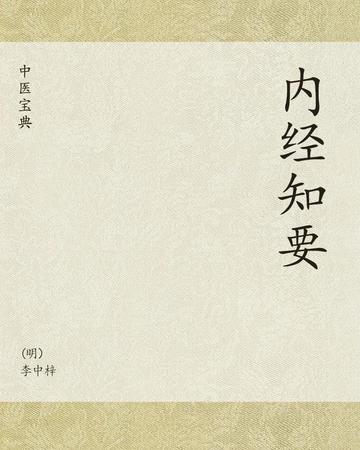
[Li Zhongzi, a master of traditional Chinese medicine in the Ming Dynasty, explained the clinical popularization of the "Nei Jing"]
The "Nei Jing Zhi Yao" is a complete book of 2 volumes. The first volume contains 5 chapters on Taoism, Yin and Yang, Color Diagnosis, Pulse Diagnosis, and Zangxiang; the second volume has 3 chapters on Meridians, Treatment Principles, and Disease Abilities. The whole book is led by Tao Sheng, advocating the combination of emptiness and spirit, the four seasons, and the truth of Tao. It uses yin and yang to cover the abdominal and back organs of the body, cold, heat, deficiency and excess of diseases. It emphasizes observing the five colors to observe the excess and deficiency of the five internal organs, the strength and weakness of the six internal organs, the rise and fall of the body, and above the diagnosis of pulse, Understand the yin and yang of the disease through descending, coming, going, arriving, and stopping; examine the interdependence and restraint of essence and qi according to the signs of changes in the internal organs; understand the flow of qi in the meridians to understand the exterior and interior, deficiency and excess; require tact to apply the principles of diagnosis and treatment; and explain various specific pathological conditions. The book has concise classification and concise reasoning. The theory of traditional Chinese medicine contained in the "Nei Jing" is clearly explained. It is highly praised by later generations of doctors and can be regarded as a must-read for introductory studies of the "Nei Jing". It embodies the unified view of man and nature in the "Nei Jing" and the idea of preventing disease before it occurs; the yin and yang categories are listed in order to guide the mind; the internal organs and meridians are then used to clarify the physiology and pathology; the color diagnosis, pulse diagnosis, morbidity, and treatment principles reflect the content of syndrome differentiation and treatment. Although there are only eight categories, physiology, pathology, and treatment are all-encompassing, reflecting the general outline of the theoretical system of traditional Chinese medicine and the purpose of the "Nei Jing".