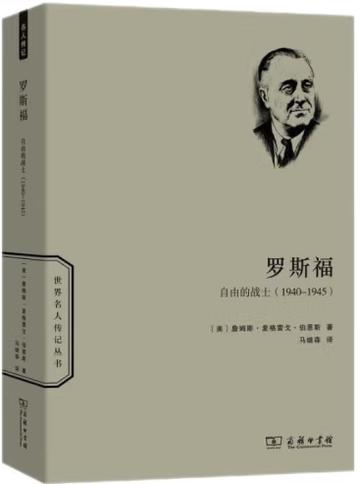
This book tells the story of Roosevelt, the 32nd President of the United States, in the second half of his life. From it, people can not only see Roosevelt's character, thoughts, and experiences, as well as his influence on American politics, military, and people's lives, but also the formation of the relationship between the United States and the former Soviet Union, the United Kingdom, and the United Kingdom, as well as the process of the creation of the United Nations. Roosevelt was ordered to respond to the economic crisis at the end of the Great Depression and the imminent war, and his "New Deal" came into being. The larger part of the book is devoted to Roosevelt's life during World War II. To encourage people who had just recovered from the economic crisis, he proposed the "Four Freedoms" in his State of the Union address - freedom of speech, freedom of religion, freedom from poverty, and freedom from fear. Roosevelt was one of the founders of the United Nations. The book describes in detail several influential international conferences during World War II such as the Yalta Conference, focusing on the relationship between Roosevelt and Stalin as well as the Soviet Union and the United States. From this, it is not difficult to see the historical origins of today's relations between the United States, the Soviet Union, and the United States and Russia. The author provides a profound and systematic analysis of Roosevelt's heart and humanity: he has freedom of thought, but is not swayed by creed like a fanatical believer. He was convinced that morality enabled him to fight effectively. "He uses the tricks of the fox to serve the intentions of the lion." The author also analyzes the shortcomings of the biography, making the work closer to history.