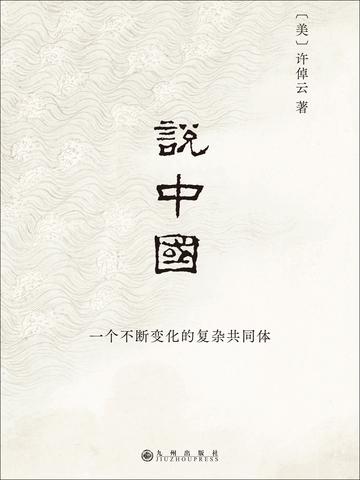
How did China become China? Is its identity based on blood, national boundaries, or culture? Swords and swords cut boundaries, but food and clothing flowed between each other; Confucianism, Buddhism, and Taoism were mixed; ethnic groups merged... How did these originally scattered and complex cultures gradually converge and shape a country called "China/Huaxia"? In the future, can this community still attract the descendants of the original members and continue to be recognized as belonging physically and mentally?
The famous historian Xu Zhuoyun talks from the Neolithic Age to the eve of the end of the Qing Dynasty, describing how the complex community of "Huaxia/China" continues to evolve.
The book does not lay out details or cumbersome arguments. It uses a broad historical perspective to select the key points in politics, economy, society, and culture of each era to outline the appearance of each era.
In the era of globalization, if you can examine your own ethnic identity principles, you will not be easily hijacked by the arrogance of intolerant ethnic groups and lose your way.
Reader comments
There are not many history books that I can calm down and read in one sitting. Maybe it's because Mr. Xu's writing style is so good and his vision is unique.
This book clearly outlines the evolution of China, a complex community, from a big historical perspective, giving me a deeper understanding of China's history. The writing style is concise and clear, the views are unique, and it is as easy to understand as chatting with friends. Especially in today's era of globalization, the thinking about ethnic identity in the book made me more aware of the importance of examining one's own ethnic identity, not being held hostage by narrow ideas, and finding one's own direction. Well worth reading!

There are not many history books that I can calm down and read in one sitting. Maybe it's because Mr. Xu's writing style is so good and his vision is unique.
This book clearly outlines the evolution of China, a complex community, from a big historical perspective, giving me a deeper understanding of China's history. The writing style is concise and clear, the views are unique, and it is as easy to understand as chatting with friends. Especially in today's era of globalization, the thinking about ethnic identity in the book made me more aware of the importance of examining one's own ethnic identity, not being held hostage by narrow ideas, and finding one's own direction. Well worth reading!