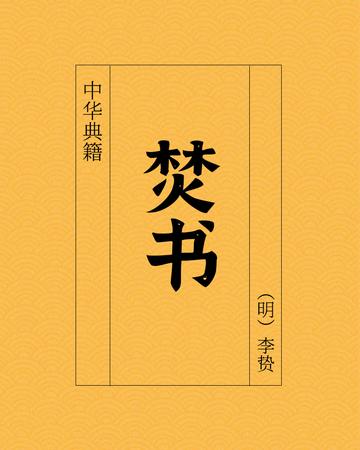
[The representative work of Li Zhi, a thinker, writer, world freedom master, and the light of the East in the Ming Dynasty]
[This book profoundly influenced the ideological liberation movement of the late Qing Dynasty, Japan's Meiji Restoration, and the May Fourth New Culture Movement]
[Yoshida Shoin, the pioneer of Japan's Meiji Restoration Movement, admitted that his view of life and death was inspired by Li Zhi's thoughts and played a decisive role in Japan's democratic revolution; therefore, China's Li Zhi is called the "father of Japan's Meiji Restoration Movement". The anti-tradition, anti-authority, and anti-dogmatic spirit expressed in the book's bold criticism of Confucianism and Cheng-Zhu Neo-Confucianism inspired and inspired progressive scholars at that time and later. It had a great impact on people's emancipation of their minds and got rid of the shackles of feudal traditional thinking. Therefore, it was regarded as a scourge by the ruling class. Li Zhi also knew that his views were not tolerated by the world, so he named his book "Burning Book". It was indeed burned many times in the Ming and Qing dynasties, but it was burned repeatedly and it was widely circulated among the people. Li Zhi's indomitable fighting spirit also became a model for later generations. Progressive thinkers during the May Fourth period regarded him as a pioneer of anti-Confucius. Li Zhi was the ideological banner of the early Enlightenment trend in China in the late Ming Dynasty, a generation of ideological and cultural giants, and a master of freedom in the world (at this time, the United States would not be founded until a hundred years later). The anti-arbitrary and anti-superstitious spirit of doubt, freedom, and social criticism he advocated also had important enlightenment and reference significance for us to correctly understand Chinese traditional culture and explore the path to rebuild modern rationality. In terms of social value orientation, Li Zhi criticized the emphasis on agriculture and suppression of business, praised the achievements of merchants, and advocated utilitarian value, which was in line with the development requirements of the budding capitalism in the middle and late Ming Dynasty. Li Zhi's life was full of criticism and reflection on tradition and history, which was also a concentrated expression of the social ideological changes in the late Ming Dynasty.
Reader comments
Mr. Zhuo Wu's classic treatise! Gengzi's source of happiness (what)



Mr. Zhuo Wu's classic treatise! Gengzi's source of happiness (what)