Spring and Autumn Period and Warring States Period
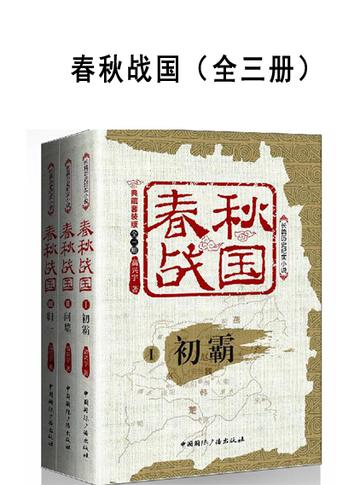
春秋战国
by Happy Yu (高兴宇)
- Status
- Completed
- Genre
- Historical
- Subgenre
- Chinese History
- Audience
- Female
- Source
- Fanqie
Stats
Tags
Synopsis
The Spring and Autumn Period and the Warring States Period were not a period of chaos, but a history that shone with benevolence, righteousness, etiquette, wisdom, faith, and courage. It left us the most glorious legacy in Chinese history. The intelligence is comparable to "Three Kingdoms", and the excitement is no less than "Journey to the West". "Spring and Autumn and Warring States": a grand historical novel containing two-thirds of Chinese idioms. Read the Spring and Autumn Period to understand the great righteousness; read the Warring States Period to increase your wisdom. The novel "Spring and Autumn and Warring States": Every page has gold, every section is a movie. If we don't read the Spring and Autumn Period and appreciate the Warring States Period, we don't understand Chinese culture. The Spring and Autumn Period and the Warring States Period: a stage where a hundred schools of thought contended, and countless heroes showed their talents. "Spring and Autumn and Warring States: First Overlord" mainly tells: After the Zhou Dynasty lost control of the world, Zheng Guo was the first to jump out and was eager to try. Later, regicide in Wei, Song, Chen, Lu and other countries was like killing a chicken. At this moment, the Chu State in the south left its back to insults and focused on taking care of its own country, thus rising rapidly and threatening the Central Plains. At the same time, the State of Qi appointed Guan Zhong to govern the country, respected the king and rejected the barbarians, making Qi Huangong the first overlord in the Spring and Autumn Period. Then, Jin and Qin in the west began to wake up and use wise men to seek development, allowing Duke Wen of Jin and Duke Mu of Qin to dominate. Song Xianggong of the Song Dynasty was also a passionate man who held high the banner of benevolence and righteousness and intended to dominate. The main story of "Spring and Autumn and Warring States: Aspiration for the Crown": Amidst the melancholy of a group of weak countries, two powerful countries, Jin and Chu, launched a century-long struggle for hegemony. The king of Chuzhuang became famous and aspired to the Central Plains. In the context of the era when ritual and music conquests originated from the princes, Zhao's Fu Gu, Ximen's annihilation of soldiers, Guo Di's alliance, Yan Zi's envoy to Chu, Er Tao killing three people, San Huan's turmoil, etc. Were staged one by one. In the long night, there are Wu Zixu's grievances, King Zhao of Chu's sorrow, King Goujian of Yue lying on firewood and tasting courage, as well as Confucius's travels, Mencius' sighs, and Fan Li's departure. The state of Wu attacked Chu, and the state of Yue destroyed Wu. In this age of great contention, big waves wash away the sand, the fittest survive, a hundred flowers bloom, and a hundred schools of thought contend. "Spring and Autumn and Warring States: Return to One" mainly tells: When poverty leads to change, and change leads to generalization, the seven powerful countries of Qi, Chu, Yan, Han, Zhao, Wei, and Qin launched a desperate battle of wits and courage. If you unite vertically, I will unite horizontally. The four Warring States monarchs including Xinling Lord, Mengchang Lord, Pingyuan Lord and Chunshen Lord, Sun Wu, Wu Qi, Sun Bin, Zhao She, Le Yi, Tian Dan, Bai Qi, Lian Po, Li Mu and Wang Jian, the ten Warring States generals, Zou Ji, Su Qin, Zhang Yi, Wei Yang, Lin Xiangru, Lu Buwei, Fan Ju, Li Si, Han Fei, Wei Liao and other famous officials of the Warring States Period, all exhausted their talents and showed their style. Things have their nature, things have their union and separation. In the end, Qin Shihuang unified the six countries.