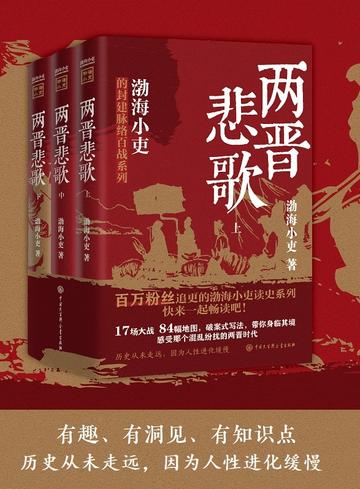
A Lament for the Two Jin Dynasties
两晋悲歌
- Status
- Completed
- Length
- 697k Words
- Genre
- Historical
- Subgenre
- Unknown
- Updated
- 2y ago
- Source
- Fanqie
Stats
23Chapters
1.2kReads
9.5Score
255Shelves
167Listens
40.1kReads · all time
Tags
Synopsis
More by this author
In booklists 7
Strong Knowledge Base, Any Topic Is Fine
Looking for books like *Gourmet Food: Starting with Running the Bear's Prison Canteen*.
738Books3.5MViews17hUpdated
Any Novels Set During the Eastern Jin and Northern and Southern Dynasties?
206Books2.4MViews1dUpdated
Show the Dark Side of Society and Portray the Twisted, Terrifying Side of Human Nature
873Books13.9MViews2dUpdated
Novels About Power Struggles During the Jin Dynasty, the Sixteen Kingdoms, or the Northern and Southern Dynasties
Looking for books similar to *Daijin*. No System or golden finger, though firearms are fine.
79Books156.2kViews5dUpdated

Looking for Books Suited to Ordinary People Struggling with Debt
Please recommend books for ordinary people in debt. Something comforting, or practical guides to help me get back on my feet.
220Books59.4kViews5dUpdated
Books Set During the Jin and Northern and Southern Dynasties or the Five Dynasties and Ten Kingdoms
Historical novels set during the Jin and Northern and Southern Dynasties, or the Five Dynasties and Ten Kingdoms period.
282Books3.9MViews8dUpdated
Ancient Chinese History: The Three Kingdoms, Song, and Ming Dynasties
I've read all of these. They have their flaws, but at least they're readable and not painfully awful.
441Books28.2MViews17dUpdated
Reader comments 31
Google Translate
It took me 35 hours and 20 minutes to read Xiao Li's "Elegy of the Two Jin Dynasties". The book is very thick, the story is very long, and the history is very rich. The long river of history is unfolding in front of our eyes, the dazzling Eight Kings Rebellion, the Yongjia Rebellion that devastated all lives, heroes and heroes one by one came to the forefront of history and then appeared briefly in the pan, leaving a few lines of names and a few deeds in the history books. The Xiongnu, Jie, Xianbei, Di, Qiang and other ethnic minorities appeared one after another... Shihu was violent, Ran Min slaughtered Jie, Qian Yan went south, Fu Jian dominated the north, Murong restored the country, Tuoba established Wei, each and every hero, accompanied by heads rolling, blood flowing in vain. Let's end with a poem by Yang Shen to commemorate the history of heroes, the devastated lives and the rolling wheel of history. The Three Sovereigns and Five Emperors of Morality were famous in the Xia, Shang and Zhou dynasties. Seven heroes and five hegemons fight against each other in the Spring and Autumn Period. Rise and fall in an instant. There are several lines of names in Qing history, and countless barren hills in Beimang. The fields of the forefathers are harvested by the next generation. It's said that dragons and tigers are fighting each other.
I don't know much about the history of the Jin, Southern and Northern Dynasties. I only know that it was very messy and miserable, just like the Five Dynasties and Ten Kingdoms. However, with the author's analysis and interpretation, the scenes can be absorbed into my mind, unlike when I watched the Five Dynasties and Ten Kingdoms, I couldn't remember anything in my head. The author's writing style is very good and quite humorous. I read the author's analysis and found it very interesting and reasonable. It was the first time I read history and I found it interesting! I have read a lot of related history books, which are not demanding, just a basic understanding of the historical context. I didn't expect to find one that I really enjoyed reading. I hope the author writes more about Chinese history. I recently read the History of Song Dynasty. I couldn't put it down after reading two books. It was not too complicated or confusing, but I was finally able to read the third one!
After reading Five Dynasties and Ten Kingdoms, it felt like a quick tour, it was very confusing but I couldn't remember anything. I thought it was the same in the Jin, Southern and Northern Dynasties, or maybe it was because the author was good at writing. I felt that the author wrote humorously and the interpretation was easy to understand and very organized. I really enjoyed reading it! The two Jin Dynasties have always been poorly understood and their sense of existence is not strong. The Western Jin Dynasty, as the author said, was born in injustice and died in shame. The Eastern Jin Dynasty was content with the politics of the clan and never had a strong attitude. It was a rather strange dynasty! Compared with the Two Jin Dynasties, other countries in the same period were much more brilliant. Compared with the Five Dynasties and Ten Kingdoms, I remember many characters: Wang Dao, Wang Dun, Liu Yuan, Shi Le, Shi Hu, Fu Jian, the Murong family... Especially Murong Chui, whose family runs through the middle and late stages of the Five Hus, makes people sigh, and suddenly I can understand Murong Fu's obsession in The Eight Parts of the Dragon!
Very well written! The history of the two Jin Dynasties is long, with many characters and complicated historical events. It is really interesting and very readable to be able to sort out the context of it. Compared with a similar book I have read before, "The Age of Gorgeous Blood", this book is so much better that it can be called a world of difference.
Although Bohai Xiaoli's book is somewhat inductive, it is generally good and there is no problem in simply understanding it.
I feel that it is well written. For the first time, I have clearly clarified the context of the two Jin Dynasties. My biggest realization is that everything cannot escape the word cause and effect. Great dynasties all originate from evolution. Don't be anxious at all.
The book "Bohai Xiaoli" is the best historical genre work I have ever read. It is detailed, has its own viewpoints, analytical techniques, and smooth writing. It is worth savoring.
The brushwork is delicate and vivid, a genius
It's clear and clear. It's much better than reading Jin's book directly.
The analysis is well-founded