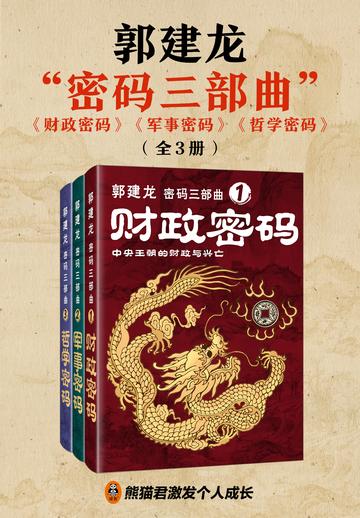
Historical writer Guo Jianlong's "Code Trilogy" interprets the rise and fall of ancient Chinese dynasties from financial, military and philosophical perspectives! "Financial Code" uses the gains and losses of the fiscal systems of past dynasties to explore the internal causes of dynasty changes! "Military Code" uses geography and war as its context to look at the success or failure of each dynasty's military strategy! "Philosophy Code" looks for the ruling logic of ancient Chinese dynasties in the context of political philosophy! Yu Minhong, Liu Suli, Yu Shicun, Yang Bin, Shi Zhan, Luo Zhenyu, Li Shuo, Zhang Mingyang highly recommend!
"Financial Code"
This book explains the relationship between the rise and fall of ancient Chinese dynasties and finance from three aspects: land system, currency monopoly, and government-owned industries. The whole book uses the three cycles of the evolution of the central dynasty's financial system as the division criteria. The first cycle covers the Qin, Han, Wei, Jin and Southern Dynasties, taking the government-owned industries established by Emperor Wu of the Han Dynasty, Wang Mang's financial monopoly, and the land and household registration system in the Wei and Jin Dynasties as clues; the second cycle covers the Northern Wei, Northern Zhou, Sui, Tang and Song Dynasties, starting with the land reform of the Northern Wei Dynasty, and discusses The land equalization system ended with the great collapse caused by the financial reforms of the Song Dynasty; the third cycle covers the Liao, Jin, Yuan, Ming and Qing dynasties, starting from the experimental fiscal policies of the Yuan Dynasty government, then discussing the conservative finance of the Ming and Qing dynasties, and ending with the efforts of fiscal modernization and its inertia in the late Qing Dynasty.
"Military Code"
This book provides a detailed analysis of the military geography of ancient China, analyzing the most critical geographical elements in the wars of past dynasties and how these elements played a role in the wars. Through on-the-spot investigation and citation of historical materials, the most typical wars and military operations of each era are selected, and the movement of strategic locations from Guanzhong to the Yangtze River Basin and border areas is illustrated, which is also accompanied by the unification, division and expansion of dynasties. It analyzes the military logic behind major wars and its impact on the rise and fall of previous dynasties.
"The Philosophical Code"
This book starts from the Western Han Dynasty and describes the ideological changes after the arrival of the era of great unification. By explaining the ins and outs of the development of philosophy, readers can clearly see how and why Chinese philosophy evolved, and understand the mystery of the interaction between politics and philosophy.
The political philosophy of the Central Dynasty can be regarded as the history of ideological formatting and counter-formatting. This book divides it into two major cycles: the first cycle started with Confucianism in the Western Han Dynasty, passed through the "rebellion" of metaphysics in the Wei, Jin, Southern and Northern Dynasties, and the birth of Buddhism, until the coexistence and competition of the three religions in the Sui and Tang Dynasties; the second cycle lasted from the Song Dynasty to the late Qing Dynasty, including the establishment of the Taoist system in the Song Dynasty, the ideological control of Neo-Confucianism, the birth and reflection of the philosophy of mind in the Ming Dynasty, and the rise and development of practical science in the Qing Dynasty.
Reader comments
The financial code reveals the underlying logic of each dynasty accurately and in detail. However, I don't quite understand the military code that establishes a new order in chaos. How do they fight? If they fight, where does the money come from? But I know that a unified dynasty needs a stable, healthy and good finance to achieve peace and prosperity for the country and the people. So I am really grateful for this book written by Guo Jianrong. I feel that I have learned a lot of knowledge and skills, so it is difficult to understand the things in it, but it has broadened my horizons and helped my thinking.
Very good and worth reading
Logic is clear and easy to understand
Very beautiful, very beautiful
Unique perspective and very inspiring
Very practical
The author has really done analysis and research.
Knowing the subtleties of the work, from point to point, enlightening people
Clear thinking, unique perspective, profound analysis and thought-provoking
The three books are all very well written. Analyzing the rise and fall of history from one perspective allows people to see the overall situation and see the context clearly.
The perspective is very unique, subverting and making up for many past perceptions. There is no limit to learning and it is worth continuing.



The financial code reveals the underlying logic of each dynasty accurately and in detail. However, I don't quite understand the military code that establishes a new order in chaos. How do they fight? If they fight, where does the money come from? But I know that a unified dynasty needs a stable, healthy and good finance to achieve peace and prosperity for the country and the people. So I am really grateful for this book written by Guo Jianrong. I feel that I have learned a lot of knowledge and skills, so it is difficult to understand the things in it, but it has broadened my horizons and helped my thinking.
Very good and worth reading
Logic is clear and easy to understand
Very beautiful, very beautiful
Unique perspective and very inspiring
Very practical
The author has really done analysis and research.
Knowing the subtleties of the work, from point to point, enlightening people
Clear thinking, unique perspective, profound analysis and thought-provoking
The three books are all very well written. Analyzing the rise and fall of history from one perspective allows people to see the overall situation and see the context clearly.
The perspective is very unique, subverting and making up for many past perceptions. There is no limit to learning and it is worth continuing.