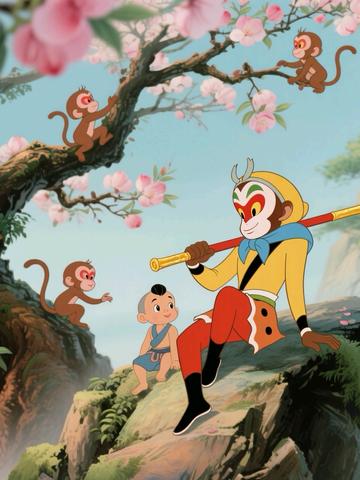
We are always rushing on the road of "learning from experience" - staying up late to change plans for promotion and salary increase, reducing the time spent with family in order to "stabilize the future", and turning "waiting when I am free" into the most frequent commitment to lovers and friends for the sake of "success" as defined by the world. Just like Sun Wukong, he went through nine or eighty-one difficulties with the obsession of "fighting and defeating the Buddha", but when he became famous, he discovered that those concerns that he regarded as "obstacles" and the companionship that he said "we will talk about it later" are exactly the "true scriptures" that should be protected in life.
This is not to deny the value of hard work, but to use the great sage's look back to tear open the packaging of "successful learning": when we regard "making money" and "promotion" as our only goals, when "home" becomes the coordinates on the map, and "friends" become the list of likes in the circle of friends, have we also become Wukong trapped by the "tightening curse"?
In the novel, the moment when Sun Wukong takes off his Buddhist robes is also the moment when every ordinary person stops - it turns out that the definition of "win" is never to rush forward alone, but to walk slowly with love and care; it turns out that the most important "sutra" is not in the distant Lingshan Mountain, but in the voice of your mother calling you to eat, in the half-bottle of wine handed over by your friend, and in the daily life that we hastily skipped and contains warmth.
When I write about the Great Sage's "return to the dust", I ultimately want to write about the "return to the heart" of every ordinary person: don't wait until the Huaguo Mountain is deserted before you look back, and don't wait until the people around you have gone far before you remember to stay. After all, what can trap us is never the "true scripture" in the distance, but the obsession that refuses to look down at our feet.