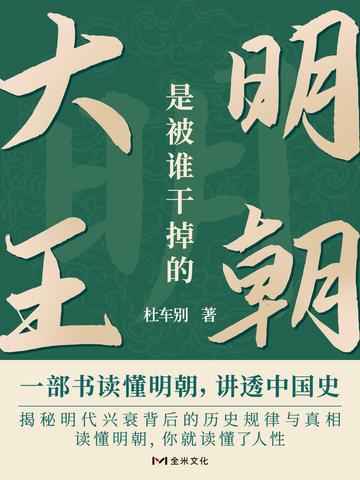
This is a historical work that aims to deeply explore the reasons for the demise of the Ming Dynasty.
The book starts from the financial crisis and military crisis in the late Ming Dynasty. Through detailed historical data analysis and logical reasoning, the book analyzes the hungry and cold soldiers, the desperate victims, the endless bandits and the root causes of the financial crisis. It conducts a comprehensive analysis of the politics, economy, military, culture and other aspects of the late Ming Dynasty, revealing the underlying reasons for the demise of the Ming Dynasty.
The core of this book is to re-examine and interpret the history of the Ming Dynasty and challenge the prejudices of traditional historiography. Such as the myth of Chongzhen's internal money, the exaggerated corruption, and the truth about excessive expropriation and so on.
This book is a work with profound historical insights. The author uses his solid research skills and rigorous logical reasoning to present a three-dimensional and multi-dimensional Ming Dynasty to readers. This book not only provides readers with a unique historical perspective, but is also a work that can deeply inspire readers to think. It has important reference value for both novel lovers and historical researchers.
That Ming Dynasty died due to authoritarian corruption is an imagination rather than a fact. Ancient China's political system developed ahead of schedule, the bourgeoisie took actual control of political power prematurely, and the country was unable to turn a developed social economy into a strong national power. As a result, the colorful Ming Dynasty ended in tragedy...
During the Ming Dynasty, China had a developed economy and prosperous industry and commerce. The Wanli period in the late Ming Dynasty was a period when business was very prosperous and the economy was very active. New ideas, new concepts, and new technologies emerged one after another, and the seeds of capitalism flourished. Why was the Ming Dynasty, which was more civilized and economically powerful, so fragile? Regarding this issue, people's minds are mostly filled with ready-made conclusions and rigid labels from various sources.
"Who Killed the Ming Dynasty" is based on the evolution of China's system from the Warring States Period to the Ming Dynasty for two thousand years. In comparison with the development process of modern Western capitalism, it explores the reasons for the demise of the Ming Dynasty based on the renewal and evolution of traditional Chinese thought and culture itself. The demise of the Ming Dynasty due to autocratic corruption is an imagination rather than a fact. The military crisis in the late Ming Dynasty stemmed from the fiscal crisis. The fiscal crisis stemmed from the deformity of the tax structure. The deformity of the tax structure stemmed from the fact that the civil service group and scholar-bureaucrats who actually controlled the political power were overwhelmingly the representatives of the interests of private industrialists (the so-called bourgeoisie in the West) due to the imperial examination system. Under their control, the country is unable to rationally allocate human, material and financial resources in society and transform a prosperous and developed social economy into strong national strength.
The advanced development of ancient China's political system led to the premature control of state power by the bourgeoisie. Although the Song and Ming dynasties gradually formed their own different institutional inertias in the game between emperors and civil servants, they were unable to successfully overcome the difficulties faced by large-scale wars and disasters. Clarifying the history of the Ming Dynasty is not only significant about the Ming Dynasty itself, but also about how to evaluate the value of Chinese civilization itself and find solutions to the many problems we are facing now. In this sense, history is a good teacher.
Reader comments
It is now 25 years old. This book is generally good and the description is objective. However, there are some areas that need to be discussed. First, the so-called Western learning. Among them, the "Qiuqi" is said to be domestically produced and cannot be compared with Western learning. There were 99 multiplication tables in the Qin Dynasty. There is a lot of evidence that modern mathematics and astronomy have been open sources in Chinese culture for a long time. High-end arithmetic is often integrated with astronomy. Second, it is overall objective but biased towards objectivity. To the civil servants, it represents the commercial capital class because they chose peace for the sake of the imperial examination. Generally speaking, the late Ming Dynasty was characterized by narrow-mindedness, selfishness, greed, and darkness evolved from ideology (Confucian culture). The so-called industrial and commercial classes were all slaves. Even if they eat, this group of people talk about their righteousness every day. They also make peace and collude with external snobbery to treat the world as a chessboard and use the numerous grassroots people as cannon fodder. The most obvious ones are civil unrest and military unrest. These people would rather not let go of anything. Chinese civilization is not Confucian civilization. What should be discarded, liquidated, and reflected on most is Confucian culture, whose poison is still there today.
This book is very interesting. It breaks the stereotypes of traditional historiography and allows us to see that the reasons for the demise of the Ming Dynasty may not be what we have always thought. The interpretation of history in the book is unique and the analysis is spot on. I especially like the author's thorough analysis of the behavior of the civil servants who control the power. But I kind of hate those people who do anything for their own interests. They are really the sinners of the Ming Dynasty! Overall, this is a book worth reading and will give you a lot of new thoughts.
It does not say that overthrowing traditional feudalism will lead to the death of the cyclical narrative, but gives different analyzes and refutations, detailed historical research, and the author's thoughtful analysis, which is of great reference value. It systematically summarizes the institutional defects of the demise of the Ming Dynasty - the country cannot perform normal functions (compared to modern times and previous dynasties).
This book is well-argued and worth recommending, and it is a bit emotional to clarify the injustice.
Very good, thanks to Teacher Du, I learned a lot... What you said is well-founded... Very rare... I like to read it
Very good, the logic is clear
I bought the physical book and I really like the teacher's point of view.
The author's research is very rigorous and well-founded.
It answers many questions about the history of the Ming Dynasty and is worth reading.
It is now 25 years old. This book is generally good and the description is objective. However, there are some areas that need to be discussed. First, the so-called Western learning. Among them, the "Qiuqi" is said to be domestically produced and cannot be compared with Western learning. There were 99 multiplication tables in the Qin Dynasty. There is a lot of evidence that modern mathematics and astronomy have been open sources in Chinese culture for a long time. High-end arithmetic is often integrated with astronomy. Second, it is overall objective but biased towards objectivity. To the civil servants, it represents the commercial capital class because they chose peace for the sake of the imperial examination. Generally speaking, the late Ming Dynasty was characterized by narrow-mindedness, selfishness, greed, and darkness evolved from ideology (Confucian culture). The so-called industrial and commercial classes were all slaves. Even if they eat, this group of people talk about their righteousness every day. They also make peace and collude with external snobbery to treat the world as a chessboard and use the numerous grassroots people as cannon fodder. The most obvious ones are civil unrest and military unrest. These people would rather not let go of anything. Chinese civilization is not Confucian civilization. What should be discarded, liquidated, and reflected on most is Confucian culture, whose poison is still there today.
This book is very interesting. It breaks the stereotypes of traditional historiography and allows us to see that the reasons for the demise of the Ming Dynasty may not be what we have always thought. The interpretation of history in the book is unique and the analysis is spot on. I especially like the author's thorough analysis of the behavior of the civil servants who control the power. But I kind of hate those people who do anything for their own interests. They are really the sinners of the Ming Dynasty! Overall, this is a book worth reading and will give you a lot of new thoughts.
It does not say that overthrowing traditional feudalism will lead to the death of the cyclical narrative, but gives different analyzes and refutations, detailed historical research, and the author's thoughtful analysis, which is of great reference value. It systematically summarizes the institutional defects of the demise of the Ming Dynasty - the country cannot perform normal functions (compared to modern times and previous dynasties).
This book is well-argued and worth recommending, and it is a bit emotional to clarify the injustice.
Very good, thanks to Teacher Du, I learned a lot... What you said is well-founded... Very rare... I like to read it
Very good, the logic is clear
I bought the physical book and I really like the teacher's point of view.
The author's research is very rigorous and well-founded. It answers many questions about the history of the Ming Dynasty and is worth reading.