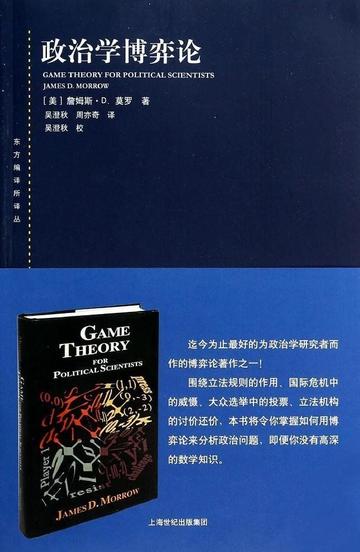
"Game Theory in Political Science" is a long-standing game theory textbook written for scholars and students in the fields of political science and international relations in the West. It does not require a high-level mathematical background like "Game Theory" by Fudenberg and Tirole, nor is it satisfied with a simple introduction to game thinking like "Strategic Thinking" by Dixit and Nairbov. The book "Game Theory in Political Science" can be said to be a moderate one. It introduces game theory systematically, allowing readers to initially master this research tool without requiring advanced mathematics. The book also provides an introduction to some basic concepts of mathematics. Not only that, this book is very helpful for us to understand the application of game theory in the fields of political science and international relations. It focuses on four important issues in this field-the role of legislative rules, deterrence in international crises, voting in popular elections, bargaining, etc.-And shows how to use game theory to analyze political issues from the beginning to the end. Although the English version of this book was published earlier (1994), political science research in the United States had just experienced a golden period of the development of formal modeling in political science at that time. The previous research results summarized in this book are particularly beneficial and appropriate for Chinese political science, which is still in the initial stage of formal modeling. Chinese political science researchers who are interested in formal modeling can use this book to gain a solid grasp of the academic foundation in this field.
Reader comments
Moreover, the book also uses game theory to analyze some important issues in political science, which gave me a deeper understanding of politics. I think it's a lot like Strategic Thinking, but a little more in-depth. I feel that this book will be very helpful to those who want to learn formal modeling!





Moreover, the book also uses game theory to analyze some important issues in political science, which gave me a deeper understanding of politics. I think it's a lot like Strategic Thinking, but a little more in-depth. I feel that this book will be very helpful to those who want to learn formal modeling!