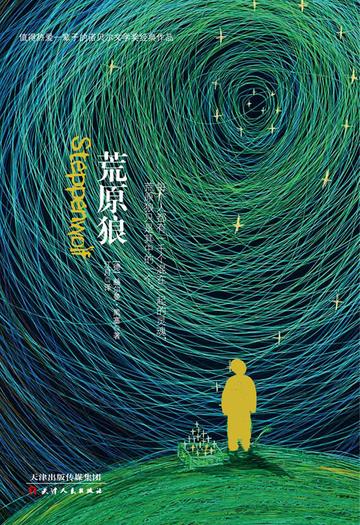
Steppenwolf (Nobel Prize for Literature)
荒原狼(诺贝尔文学奖作品)
- Status
- Completed
- Source
- Fanqie
Stats
Tags
Synopsis
Reader comments
In booklists 16

Sanjiu Has a New Book Out! ! !
Hey hey hey, you all know how to hand over your good books

Books That Students Should Read, In-Volume Essentials
Mathematics, Chinese, English, chemistry, physics, biology, geography, history, ancient poetry...
Nobel Prize for Literature, Mao Dun Literature Prize, Lu Xun Literature Prize and Other Literary Works
I want to read a book similar to "One Sentence is Worth Ten Thousand Sentences: Collector's Edition".
Are There Any Teaching Aid Books?
I want to read a book similar to "Half-hour Comic History of China 5". For example, the above
Like Literary Classics
I want to read a book similar to "La Traviata". I think this book is well written. I recommend it.
Nobel Prize in Literature Works with a Score of 9.0 or Above



9.9 High Score, Super Exciting and Watchable
I want to watch content similar to "Famine in the 1960s and Going to the Countryside in the 1970s". Various categories

A Must-Read for Chinese Language and Literature Majors
Are there any books that can actually help improve your writing and expression skills?
Literature Books, I Want Literature Books! ! !
Family members, I want to read literature books, books that can improve my writing skills or increase my knowledge. Beg on your knees!


The End of Fiction Is Literature…
I want to read a book similar to "Morning Blossoms Plucked at Dusk". Masterpiece! Study! Book!



Let's Have Some Monthly Shock
Requirements: Monthly calculation/good-looking/normal


Books with Outstanding Literary Talents That Amaze the World
Books similar to "There is a Ghost in My Body", "The Little Confucian Immortal Who Tongyou" etc.



Looking for Books Suitable for Students in the Second and Third Grade of Junior High Schoolᶻz ₍^_ ̫ _^₎
Now that I'm in my second year of junior high school, I'll look for some academic or literature books, which cover all subjects, preferably ones that junior high school students can understand.
I Want Be Stories, Not Brainless Stories, Not Double-Male (Female) Stories!
I want to read a book similar to "She Stops Coaxing Him". I want the kind of text that makes people cry, not too long, and I want to read it at night. I'm a big fan of be text! Thank you all! (´⌣`ʃƪ)


Are There Any Novels with Novel Themes?


Looking for Good Books
Any good book will do
The writing style of this book is unique and full of poetry and philosophy. From the perspective of Steppenwolf, the author made me feel the inner struggle of a lonely person. I once had the experience of neglecting my studies, and I deeply regretted it. This book made me understand that we may all be lost in life, but it is important to find our own direction and bravely face our inner fears and confusions. It taught me to cherish life and pursue my true self.
"The purpose and outcome of this new life is not peace and tranquility, but always new self-destruction and new self-transformation." Here Hesse denies the perfect and harmonious state in "Siddhartha", pointing out that this perfection is instantaneous and cannot exist for a long time, and will be followed by new pain and new cycles. This never-ending cycle of pain is terrifying. Maybe the only way out is to escape and die? In fact, there is only one way to break the situation, and that is - face it, accept it, and embrace it! Think of the land and sea, which carry the abundance of all things and also accept the dirt of all things. Like the land and the ocean, tolerate everything in this world, especially - tolerate yourself. "When all children are born, they represent separation from the universe, freedom from God, and embarkation on the painful path of rebirth. If you want to return to the universe, stop the painful individualized life, and then cultivate yourself to become a god, you must open your mind and expand your soul so that the soul can accommodate the entire universe." The process of understanding the world is the process of discovering oneself, and I am the universe.
In this book, Harry uses himself as a prototype to have a dialogue with his other self, Steppenwolf. For many days and nights, he switches between magic and reality like a schizophrenic, switching freely. They talked about scholars, lovers, love, war, and felt helpless and contemptuous of the arrival of the God of Destiny... In the process, they discovered that every complete soul is composed of thousands of different clones, and then further explored reality and dreams and the intertwined fate of different selves. It is as vast and boundless as the ocean. In this big and small world, human destiny is not always full of happiness and contentment, but also indifferent, filthy and dirty... Fortunately and misfortune are inseparable at any time.
People facing existential crises, people who feel lonely and self-doubt, or people who are confused and at a loss what to do, can read this book. It has indeed given me a lot of inspiration from different perspectives. The following are my scattered feelings (only one aspect will be discussed below) We are used to using label thinking to measure a person, or to define ourselves, which is understandable. After all, rationally speaking, label thinking is actually a kind of brain-saving, simple and efficient behavior, and it also helps to form a community culture (this is easy to understand, such as i people and e people). But if it is excessive, it is possible (I will not make an absolute statement here) that it will fall into the halo effect (excessive expectations of others) and thinking solidification (defining oneself hijacks one's own development possibilities) In fact, I am not exempt from vulgarity. I was addicted to the so-called MBTI psychology some time ago and used those few letters to frame the boundaries of my behavior. This did give me some sense of belonging. I confirmed that I belonged to those four letters. Those loneliness, aloofness, and stubbornness seemed to have found reasonable explanations. But when I indulged too much, I reflected on it, did this limit my other possibilities? Woolf's words "I have roots, but I flow" illustrate to a certain extent that people are not static and should be viewed dynamically, rather than viewing themselves and others in a static, isolated, metaphysical way. There may be humans and wolves in everyone's heart, but it's not just about the coexistence of humans and wolves. As the saying goes, "People have thousands of faces and hearts have thousands of changes." A passage in the article touched me deeply. Harrell thought that in his heart was the confrontation between steppenwolf and humans. In fact, what existed in his heart was not just these, but more people and more animals. He has an idealistic side, a realistic side, a stubborn and rigid side, and a gentle and polite side. He can be a human, a wolf, a fox, a rabbit... (This actually reminds me of Berlin's classic analogy between foxes and hedgehog scholars. Harrell may be both a fox and a hedgehog, pursuing and knowing many things, but the pure pursuit of improvement in his heart, or perfectionism, is his deepest desire) The most important thing is that he is himself, made up of every image, and is by no means bound by labels (humanity and wolf nature). All in all, I don't need to reject label culture. What I mean is actually very simple – labels and definitions are means, not ends. It is the anchor of your existence, but it is by no means your existence itself. We accept the part defined by our own label, but we are not bound by it, and we do not deny the existence of other possibilities. We have roots and we flow, that's all. (Personal opinion, sorry for inappropriateness) It was still very shocking after reading it. The final ending was blurry as to whether it was true or false. I even wondered whether Hermina, Maria and others were part of his hallucinations or literary metaphors. But whether it's an illusion or an artistic technique, Harrell started his life again and learned to face the absurdity alone. This was enough.
(Personal understanding, I don't know whether it's right or wrong) Mental pain comes from the instinct of life. Just because I want to live, I want to die. Suicide is the last trace that proves that I can make my own choice. Therefore, it should be noted that suicide is not numbness, but a manifestation of seeking life. When life is full of barbs, moths fly into the flames, which may be filled with hot life, but it may not be true wisdom. When you no longer belong to yourself, but become a doll that can be manipulated at will, the final freedom is nothing more than deciding your own life or death. Regardless of the individual or the era, it is precisely because of the expectation that one can embrace the purest life that one walks alone towards the desolation of death. This is a conspiracy between ideals and reality, and one dies under the knife of oneself and others. And true spiritual transcendence often comes from the part of self-denial. A person's imperfections often breed true greatness. Faced with such a incomplete world, the real choice may be to embrace those insurmountable gaps and reconcile with nature and life. I think this may be the embodiment of the "humor" mentioned in the book.
If you have ever felt out of tune with the world late at night, living like an "outsider" among the crowd, repeatedly torn between "integrating into the world" and "holding on to yourself" - then Hesse's "Steppenwolf" will be a soul monologue written for you. Harry Harrell, the man known as "Steppenwolf", has the shadow of everyone: he has the gentleness of "humanity" and the unruliness of "wolf nature". He hates the hypocrisy of the world and longs to be understood; he yearns for spiritual freedom, but cannot escape the shackles of reality. Hesse used sharp and gentle brush strokes to dissect the struggle of his soul - those questions about loneliness, self-division, and spiritual dilemma are exactly the most secret resonances in modern people's hearts. This is not a book that sells anxiety, but a profound self-redemption. In the tug of "human nature" and "wolf nature", Harry gradually understands: The so-called maturity is not to eliminate the "wolf" in the heart, but to coexist with it; the so-called freedom is not to escape from the world, but to still adhere to the abundance of the spirit after recognizing the world. Hesse's philosophical thinking is hidden between the lines, including reflection on civilization, compassion for human nature, and gentle acceptance of every lonely soul. Recommended to all those who feel lonely in the hustle and bustle, those who are struggling with spiritual internal friction, and those who are confused on the way to find themselves. Opening this book, you will find: your loneliness has never been alien, your struggle has long been understood, and the courage to reconcile with yourself is hidden in Harry's story. I hope every "Steppenwolf" can find resonance in the book and find a spiritual habitat after pulling himself apart.
This book is not easy to read, and it is an electronic version. Compared to Demian's core experience, I still don't quite understand many of Steppenwolf's behaviors and inner world. It may be that I haven't experienced it in real life. I read this book on and off for half a month. My ability to pass the time when I first started working made my self-control a bit weaker. This does not mean that my enthusiasm for reading has weakened. It is just that the fixed reading time has been greatly weakened from the psychological level due to the trivial matters at work, and my reading ability has also declined. I may have to read many paragraphs and words repeatedly, and I have to read the previous text to correspond. This greatly reduces the efficiency of reading, but it's okay. I don't have a fixed amount of reading, so I don't need to set some goals, as long as I'm still reading. I may need to slow down a bit later. I originally wanted to continue reading Hesse's Klingsor's Summer, but I thought I would slow down first and read some other types of books. I want to read something from China. One sentence by Liu Zhenyun is worth ten thousand words. He said it is very good. Do you have any recommendations? Any modern one will do.
The protagonist Harel is heavy, melancholy, and alone. He is quiet, reserved, and maverick. His loneliness and forbearance are unparalleled. And if a person wants to live well, he must find a way that suits him and bloom in the soil that suits him. "Steppenwolf" tells us that acceptance is healing, and living is ordinary. I hope each of us can forgive ourselves more and be more tolerant of others~
I envy Harry very much because he can personally experience everything in this dream, analyze reality in person, and analyze the soul, passion, indifference, kindness, helplessness, and madness hidden deep in his heart. And I, as a bystander, also used this book to get an overview of my experiences along the way; I am very lucky that at this point in high school, I can use a book to end the past and restart my life. Whether good or bad, countless "me"s in the future will leave answers.
Such a schizophrenic philosophy has a kind of Ah Q's spirit, but it is also rational. Perhaps it is a disease of highbrow and melodiousness. No one understands it. Everyone in the world is drunk, but I am the only one awake!
To be honest, reading such a profound book is incomprehensible to someone with low literary attainments like me. It was very painful for me during the middle of reading, because I didn't understand various spiritual topics, such as war and so on. Anyway, the general reading is that Steppenwolf is actually a person with dual attributes, and the wolf nature is the bad side. He couldn't see the meaning of life and wanted to commit suicide, but he met Hermina and Maria, Palero and others slowly saved him. It seemed that there was a magic theater. They were originally in reality and then came to the magic theater. Everything in the magic theater was like a parallel world. In this world, the stories progressed slowly one by one, but Harry found that he had ignored a lot of earthly happiness before, well... That's probably it.
You may forget the book you read in a month, but maybe just one or two sentences left a deep impression on you. Sometimes the fun of reading a book is to cultivate the ability of interpretation invisibly - to restore the creative intention of the story and see the essence through the phenomenon.
It's a very good book, although I didn't understand it because it was too obscure.
Following the book is like peeling off the real self bit by bit, slowly and slowly.
Why isn't there the last part?
Ended on March 30, 2026. Those lyrics come to mind: There are two me in the world, one is pure, one is mottled, one is fickle, one is persistent, one is smiling forcefully, one is pretending to be silent, one is squandering his soul, and the other is curled up in his body...
It's a wonderful feeling so far. I look forward to the surprise of the Nobel Prize for Literature.
Steppenwolf is precious
A man called "Steppenwolf"...
Awe of the spiritual world
A thought-provoking book
A lonely man sees the world
How should I put it, I still feel like I'm not very good at reading this kind of stream-of-consciousness novel, but I just feel like I want to continue reading.
Am I the only one who thinks I am Steppenwolf? [Crying]
After reading this "German Ulysses" in two days, in this modern age of internal strife and anxiety, I want to think about how to reconcile with myself while maintaining an enterprising spirit (wolf nature).
A very special literary masterpiece that introduced me to the character of Steppenwolf.
I'm confused, I don't understand [cover face] [cover face], is there something missing? In the end, Maria died before she could answer the question.
You can read it if you recommend it, but I recommend another book, The Way of the Wolf