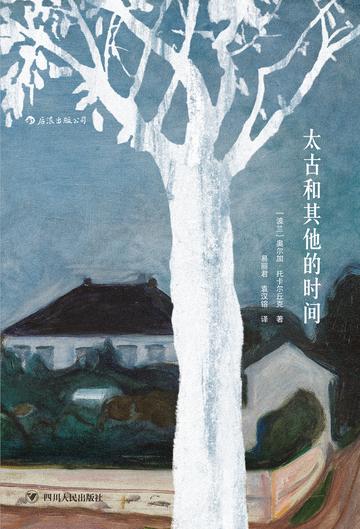
"The Ancient Times and Other Times" is a famous work by the famous contemporary Polish writer Olga Tokarczuk. The novel has a total of 84 chapters, each chapter is named after "xxx time". It tells the stories of various characters in ancient times, even animals, plants and things, from different perspectives: a girl who touches the border of the world, a landowner addicted to puzzle games, a lonely housewife, an old woman who curses the moon, and even angels, water ghosts, pugs, mycelium, small coffee grinders... The life stories of three generations reflect the turbulent historical destiny of Poland in the 20th century.
Primeval is a place, located at the center of the universe. Its four borders are guarded by four angels. The world beyond the ancient times does not exist. People who think they have stepped out of the ancient times are actually standing on the border and dreaming that they have entered the outside world. When they wake up, they go home and regard their dreams as memories. Borders also produce ready-made people, as if they came from the outside world...
Reader comments
Thinking back to when I was looking for a job after graduation, I felt like I was exploring an unknown boundary. Although the stories in the book are illusory, they also made me feel the diversity and possibilities of life. Just like the ancient times, our lives also have countless time and space waiting for us to discover and explore.
Tokarczuk weaves a Polish national epic from 84 perspectives. Taikoo, a village located at the center of the universe, is both a real geographical space and an imaginary boundary of time and space - those who try to cross will fall into a dream and can only wake up when they intend to return.
Reality and myth intersect, and historical trauma is deconstructed into fragments: a girl touches the border, a landowner becomes obsessed with puzzles, a witch comes alive, and an old woman curses the moon. These fragments are independent and connected through emotions to form the long history of Poland in the 20th century. Tokarczuk pushes phenomena to their limits, disintegrates them, and then reintegrates them, making God, angels, linden trees, and coffee grinders all the narrators of time.
God ceases to move, and the stillness brings disintegration, but in disintegration it opens up the eternal existence beyond time. The three generations of Taikoo have gone through wars and separations, and have continued to live among the fragments.
She roots everything in the soil of her hometown. Her words remind you and me that looking at the world in fragments will lead to bias, and writing uses temperature to shorten the distance between fragments. The ancient is always there, outside of time, in the dreams of all those who return.
This is an unforgettable book with concise language and descriptive descriptions.

Thinking back to when I was looking for a job after graduation, I felt like I was exploring an unknown boundary. Although the stories in the book are illusory, they also made me feel the diversity and possibilities of life. Just like the ancient times, our lives also have countless time and space waiting for us to discover and explore.
Tokarczuk weaves a Polish national epic from 84 perspectives. Taikoo, a village located at the center of the universe, is both a real geographical space and an imaginary boundary of time and space - those who try to cross will fall into a dream and can only wake up when they intend to return. Reality and myth intersect, and historical trauma is deconstructed into fragments: a girl touches the border, a landowner becomes obsessed with puzzles, a witch comes alive, and an old woman curses the moon. These fragments are independent and connected through emotions to form the long history of Poland in the 20th century. Tokarczuk pushes phenomena to their limits, disintegrates them, and then reintegrates them, making God, angels, linden trees, and coffee grinders all the narrators of time. God ceases to move, and the stillness brings disintegration, but in disintegration it opens up the eternal existence beyond time. The three generations of Taikoo have gone through wars and separations, and have continued to live among the fragments. She roots everything in the soil of her hometown. Her words remind you and me that looking at the world in fragments will lead to bias, and writing uses temperature to shorten the distance between fragments. The ancient is always there, outside of time, in the dreams of all those who return.
This is an unforgettable book with concise language and descriptive descriptions.