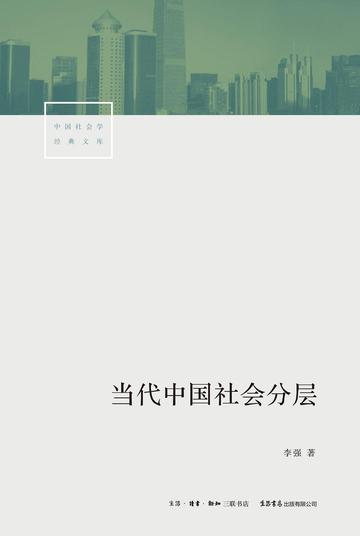
Social stratification exists objectively in any society and in any historical period. "Social Stratification in Contemporary China" conducts a comprehensive discussion on the historical formation, current situation, and future direction of China's social stratification in the past 40 years of reform and opening up. China's social structure used to be an inverted "T-shaped" structure, but with the rapid development of Chinese society, Chinese society has now formed a "local-shaped" structure. The changes in China's social structure depend on the development and growth of China's middle class. Sociological research has proven that in modern society, the middle class is the most important social force that maintains the stable development of society. A large-scale and diverse middle class is the political, economic, and ideological foundation for maintaining social stability. This book also provides meaningful discussion and research on issues such as the gap between the rich and the poor in China.
Reader comments
Some people say that this book marks the maturity of the understanding of Chinese social classes. I personally agree with this view. The profound understanding and forward-looking views have had a great impact on my understanding of this society. If you can calm down, I personally recommend reading it.
There are many professional words in the book and the articles are quite in-depth. To read this book, you need to have strong knowledge reserves and determination to persevere.
This book is very in-depth and gave me a clearer understanding of the stratification of Chinese society. I especially liked the discussion of the middle class in the book, which reminded me of the book Style, both of which provide in-depth analysis of social class. Social stratification is a very complex topic, but this book explains it in an easy-to-understand way, which is very suitable for entrepreneurs like me to understand the current situation of society. Recommended to friends who are interested in social structure!
I have a deep understanding of modern Chinese society and it takes some effort to read it.
A good book with a new perspective.
Reasonable and convincing
It's a very good book. It's my problem that I can't understand it, not the book's problem.
Very good, prosperous, in a trance, hahahaha
The voice is concise, clear and easy to understand
It's great to read. It's the second book I've come across after "Native China" that has a lot to do with sociology. Are the words so closely related to actual policies?
Look at the problem from multiple angles, objective facts, well written

Some people say that this book marks the maturity of the understanding of Chinese social classes. I personally agree with this view. The profound understanding and forward-looking views have had a great impact on my understanding of this society. If you can calm down, I personally recommend reading it.
There are many professional words in the book and the articles are quite in-depth. To read this book, you need to have strong knowledge reserves and determination to persevere.
This book is very in-depth and gave me a clearer understanding of the stratification of Chinese society. I especially liked the discussion of the middle class in the book, which reminded me of the book Style, both of which provide in-depth analysis of social class. Social stratification is a very complex topic, but this book explains it in an easy-to-understand way, which is very suitable for entrepreneurs like me to understand the current situation of society. Recommended to friends who are interested in social structure!
I have a deep understanding of modern Chinese society and it takes some effort to read it.
A good book with a new perspective.
Reasonable and convincing
It's a very good book. It's my problem that I can't understand it, not the book's problem.
Very good, prosperous, in a trance, hahahaha
The voice is concise, clear and easy to understand
It's great to read. It's the second book I've come across after "Native China" that has a lot to do with sociology. Are the words so closely related to actual policies?
Look at the problem from multiple angles, objective facts, well written
Worth recommending, a very good book