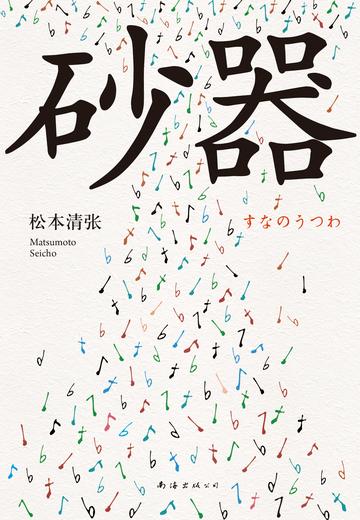
[Editor's Recommendation] ★One of the masterpieces of Japanese literary giant Seicho Matsumoto, it is known as a classic of socialist reasoning.
★The lonely child is making sand vessels by the silent river. When it was first formed, heavy rain came unexpectedly.
★After many reasonings, the answer to the mystery is revealed in the sad reality, which reveals the humbleness of human nature, which is moving and thought-provoking.
★When I was in college, I read all the works of Matsumoto Seicho. He is one of the few writers who can keep me reading. ——Keigo Higashino
★I am a huge fan of Seicho Matsumoto. ——Shoji Shimada
★"Sankei Shimbun" reported that "Sandware" has sold at least 4.3 Million copies, influenced several generations, and remains a best-seller to this day.
★The Japanese drama of the same name won the Japanese Drama Academy Award for Best Work and Best Actor; the film of the same name, directed by Yoshitaro Nomura, was once popular in China and ranked among the top 10 works of the "Film Weekly" Awards.
[Introduction] "Sand War" is an immortal masterpiece by the Japanese literary giant Seicho Matsumoto. It has been adapted into movies and TV series several times. It is an enduring and timeless classic among fans of mystery novels. Represented by "Sandware", "Points and Lines" and "Focus of Zero", Matsumoto Seicho's works have profoundly influenced many important Japanese writers such as Higashino Keigo, Shimada Shoji, Miyabe Miyuki, Kyogoku Natsuhiko, etc. Higashino Keigo once said, "I read all Matsumoto Seicho's works when I was in college. He is one of the few writers who can keep me reading." It was precisely because of his exposure to Seicho Matsumoto that Keigo Higashino changed from a student who hated reading to a fan of mystery novels, and has since embarked on the path of creation. The Japanese drama of the same name adapted from "Sandware" won the Japanese Drama Academy Award for Best Work and Best Actor; the film of the same name, directed by Yoshitaro Nomura, was once popular in China and ranked among the top 10 works of the "Film Weekend" Awards.
The story of "Sandware" makes people feel emotional: Tokyo, three o'clock in the morning. A male body was found under the wheels of the first train on the Keihin Tohoku Line. The cause of death was suffocation. His face was hit with a blunt object, and his appearance was completely disfigured. What kind of hatred would it take to commit such a murderous act? The police tried their best, but could not even confirm the identity of the deceased. The case became a mystery, and only the old detective Imani was unwilling to stop. Soon, two people died in a theater troupe one after another, which were determined to be suicides and accidents respectively. Then a pregnant single woman died unexpectedly. In the crowded Tokyo, these little people were inconspicuous, irrelevant, and died quietly. Imanishi thought so at first, but accidentally he discovered that he had made a fatal mistake.
[About the author] Matsumoto Seicho (1909-1992)
Japanese writer who has won the Akutagawa Prize, Eiji Yoshikawa Literary Prize, Kan Kikuchi Prize, Mystery Writers Association Award, etc. His work "Points and Lines" pioneered socialist mystery novels, and his representative works include "Zero's Focus" and "Sandware".
Reader comments
Is Sekikawa just jealous? ! The previous extensive description led the suspect to Sekikawa, and Wakata appeared from someone else's perspective and finally turned into a murderer. And it can be said that there is evidence to prove that Waga killed Miyata and Emiko, but what evidence is there to confirm that he killed Miki Kenichi? The witness at the bar did not see a face, no murder weapon, no fingerprints, no DNA, only inferences, so I think it would be impossible to prove his guilt of killing Miki Kenichi without Waga's personal admission.
The story of this book is truly amazing! Every detail was full of suspense and kept me wondering what the truth was. I especially like a sentence in the book: "The lonely child is making sand vessels by the silent river." This sentence made me feel the protagonist's inner loneliness and helplessness towards his fate. Moreover, the characters in the book are very vivid, and I seem to be able to see them vividly interpreting the story before my eyes. What a wonderful novel!
This book was written very early, and it can be said that many people later borrowed its techniques, so it was considered excellent from that era. The character of Miki is so perfect that it feels unreal.
Although it is an open ending, it is very exciting
Well enough. It's just too long
Seicho Matsumoto's masterpiece of socialist style
The description is very subtle, the characterization is very detailed, and the description of the environment is also very objective! Readable
A wonderful novel, worth reading.
It's good-looking, although I guessed the murderer wrong earlier.

Is Sekikawa just jealous? ! The previous extensive description led the suspect to Sekikawa, and Wakata appeared from someone else's perspective and finally turned into a murderer. And it can be said that there is evidence to prove that Waga killed Miyata and Emiko, but what evidence is there to confirm that he killed Miki Kenichi? The witness at the bar did not see a face, no murder weapon, no fingerprints, no DNA, only inferences, so I think it would be impossible to prove his guilt of killing Miki Kenichi without Waga's personal admission.
The story of this book is truly amazing! Every detail was full of suspense and kept me wondering what the truth was. I especially like a sentence in the book: "The lonely child is making sand vessels by the silent river." This sentence made me feel the protagonist's inner loneliness and helplessness towards his fate. Moreover, the characters in the book are very vivid, and I seem to be able to see them vividly interpreting the story before my eyes. What a wonderful novel!
This book was written very early, and it can be said that many people later borrowed its techniques, so it was considered excellent from that era. The character of Miki is so perfect that it feels unreal.
Although it is an open ending, it is very exciting
Well enough. It's just too long
Seicho Matsumoto's masterpiece of socialist style
The description is very subtle, the characterization is very detailed, and the description of the environment is also very objective! Readable
A wonderful novel, worth reading.
It's good-looking, although I guessed the murderer wrong earlier.