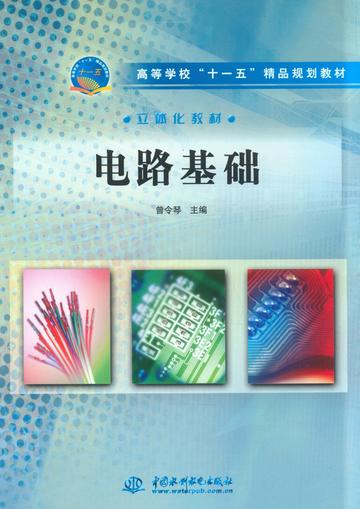
This book is written and formulated according to the requirements of the training objectives of "application-oriented" and "skill-oriented" talents. The theoretical content mainly includes: basic concepts and laws of circuits, circuit principles and basic analysis methods, single-phase sinusoidal AC circuits, phasor analysis method, resonance, mutual inductance coupling circuits and transformers, three-phase circuits, transient analysis of circuits, non-sinusoidal periodic current circuits, two-port networks, uniform transmission lines and Laplace transform. The practical teaching content includes experimental guidance related to theoretical content, as well as electrician training projects that focus on the cultivation of students' quality and the cultivation of application-oriented talents. It truly focuses on the application of engineering technology, so as to not only serve students' subsequent courses, but also directly serve the cultivation of engineering technology application capabilities, which is highly practical. In order to facilitate teaching and learning, the teaching materials are provided with teaching syllabus, teaching courseware with high practical operation performance, test question bank and detailed analysis of exercises, etc. This book can be used as a textbook for various electrical majors in colleges and universities, and can also be used as a reference for relevant scientific and technological personnel.
Reader comments
I have roughly read a few chapters and compared them with more than a dozen related books that I have browsed. I feel that this is a good textbook that is most suitable for beginners to comprehensively and systematically self-study the basics of electrical engineering. It is especially friendly to beginners or readers who do not have a solid foundation in electricity. It can make up for the knowledge areas with weak foundations, greatly reducing the difficulty of learning for beginners! Thanks to the editors and teachers for their dedication!



I have roughly read a few chapters and compared them with more than a dozen related books that I have browsed. I feel that this is a good textbook that is most suitable for beginners to comprehensively and systematically self-study the basics of electrical engineering. It is especially friendly to beginners or readers who do not have a solid foundation in electricity. It can make up for the knowledge areas with weak foundations, greatly reducing the difficulty of learning for beginners! Thanks to the editors and teachers for their dedication!