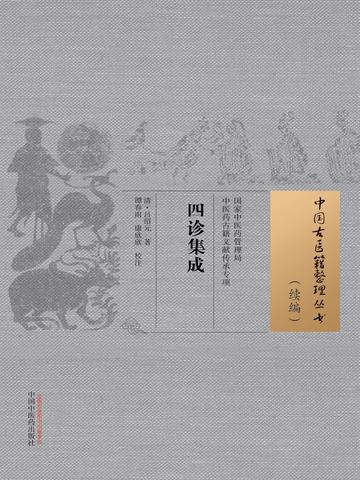
"Ordinary doctors look at diseases, examine the deficiency and excess of yin and yang, and distinguish the severity of sadness. They are roughly the same as observing color, observing speech, differentiating syndromes, and observing breath. There is no such thing as the practitioners in the world, who only focus on three, and ignore many things such as looking, hearing, and asking. Even those who compile books all focus on pulse diagnosis first, and leave the three behind, and are simply unprepared. When looking at the disease in the internal organs and meridians, test from the outside to the inside, leaving aside the three. However, it is extremely difficult to see everything with just three fingers." Lu Shaoyuan inherited the view of attaching great importance to the four diagnostic methods since the Ming and Qing Dynasties. "Hereby collects and collects the words of sages and philosophers, listens and inquires about them, and compiles them into a series to clarify their essence and clarify the right and wrong, so that beginners can learn to recite them, so that they can have definite opinions in their minds and not be confused by what seems to be." He wrote the first draft of "The Collection of Four Diagnostics".
The manuscript of Lu's "Collection of Four Diagnoses" "concisely outlines the outline, summarizes the elements, adopts the essence of the predecessors, and determines the style and method of future generations". It can indeed "be the correct step for examining syndromes and pulses" and has high theoretical and practical value. Therefore, the two monarchs together with their friends and disciples, Adhering to the purpose of "according to the "Nei Jing", "Golden Chamber" and other books, they are consistent with the sages' original purposes, and then adopted them." Lv's first draft was again "cut out the redundant and simplified, removing the dregs and retaining the essence", and finally completed the "Collection of Four Diagnoses", which was divided into eight volumes according to the number of words. Among them, Volumes 1 to 3 cover visual diagnosis, Volume 4 contains three parts: vision diagnosis, smell diagnosis, and interrogation, and Volumes 5 to 8 cover pulse diagnosis.
Reader comments
This "Integration of the Four Diagnostics" is comprehensive in content, covering everything you need to know, read, and ask. It also emphasizes the importance of the four diagnostics combined with ginseng. It is very practical! It feels a bit similar to the "Huangdi Neijing", both classics of traditional Chinese medicine. The author Lu Shaoyuan is really amazing. He can organize such complicated knowledge so clearly. Moreover, he and his friends proofread and annotated this book. I am so impressed! I think this book is a good introductory guide for people who want to learn Chinese medicine.


This "Integration of the Four Diagnostics" is comprehensive in content, covering everything you need to know, read, and ask. It also emphasizes the importance of the four diagnostics combined with ginseng. It is very practical! It feels a bit similar to the "Huangdi Neijing", both classics of traditional Chinese medicine. The author Lu Shaoyuan is really amazing. He can organize such complicated knowledge so clearly. Moreover, he and his friends proofread and annotated this book. I am so impressed! I think this book is a good introductory guide for people who want to learn Chinese medicine.