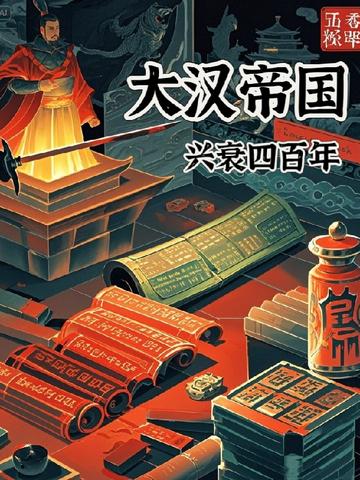
"The Rise and Fall of the Han Empire in Four Hundred Years" uses the edge of a sword to lift the curtain of the troubled times of the late Qin Dynasty. Liu Bang, the pavilion chief of Surabaya, rises from the dead by slaying the white snake, and casts the wild and heroic spirit into the backbone of the Weiyang Palace. Lu Pheasant's sleeves were covered with frost, weaving the warp and weft of political strategy in the blood-colored court; Emperor Wu of the Han Dynasty trampled the court of the Xiongnu to pieces with his horse's hooves, and the frost of northern Mobei condensed on the edge of his bronze sword. In the four-hundred-year long scroll, Confucian scholars hold bamboo slips and knock at the door of destiny, knights carry long swords to measure the borders of the four seas, and silk wrapped in camel bells spreads the moonlight of Chang'an to the Western Regions. Wang Mang used prophecy as a blade to cut open the lifeline of the dynasty, and Guangwu used Yuntai Twenty-eight to restart the country, but he never escaped the undercurrent of his relatives and eunuchs. When Dong Zhuo's cavalry crushed the Luoyang palace, this era that was once named "Han" left behind in the vast twilight the intertwined scenes of the Yellow Turban beacon fire, the salt and iron debates, and the long song of Yuefu - it carved the first complete imperial growth ring for China with blood and literary ink.