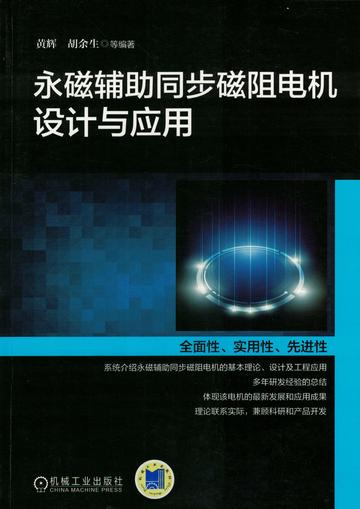
The permanent magnet-assisted synchronous reluctance motor combines the characteristics of synchronous reluctance motors and permanent magnet motors, which can reduce the performance requirements for permanent magnets. It has the advantages of high power density, high efficiency, and low cost. It has broad application prospects and can be applied to air conditioning, mechanical equipment, new energy electric vehicles and other fields.
This book summarizes the author's many years of research results on permanent magnet-assisted synchronous reluctance motors as well as new developments and applications in the industry. It is divided into six chapters: Chapter 1 introduces the development history and research status of permanent magnet-assisted synchronous reluctance motors; Chapter 2 starts with the motor. Starting from the operating principle of the motor, we study the influence of the number of permanent magnet layers, air gap, winding form, permanent magnet content rate, permanent magnet dosage, and permanent magnet residual magnetism on the motor parameters and performance; Chapter 3 introduces the basic principles of demagnetization and magnetization of the motor, and discusses the number of permanent magnet layers, The influence of permanent magnet thickness, pole arc coefficient, magnetic isolation bridge, magnetizing direction, permanent magnet embedding depth, winding form, stator split ratio, number of pole pairs and other parameters on the motor's ability to resist demagnetization; Chapter 4 summarizes the generation mechanism of electromagnetic vibration and noise of the motor, starting from the winding Noise reduction design research is conducted on the form, motor magnetic circuit structure, inverter control and other aspects; Chapter 5 studies the control principle and vector control strategy of the motor; Chapter 6 introduces the application of the motor in air conditioning compressors, new energy electric vehicles and industrial fields.
Reader comments
The permanent magnet-assisted synchronous reluctance motor mentioned in the book has the advantages of high power density, high efficiency, and low cost. This is what our entrepreneurs are pursuing. I particularly like the parts about motor control principles and vector control strategies in the book, which are very detailed and clear. I have benefited a lot from the research results of comrades such as Huang Hui and Hu Yusheng. I believe this book will be helpful to many entrepreneurs.





The permanent magnet-assisted synchronous reluctance motor mentioned in the book has the advantages of high power density, high efficiency, and low cost. This is what our entrepreneurs are pursuing. I particularly like the parts about motor control principles and vector control strategies in the book, which are very detailed and clear. I have benefited a lot from the research results of comrades such as Huang Hui and Hu Yusheng. I believe this book will be helpful to many entrepreneurs.