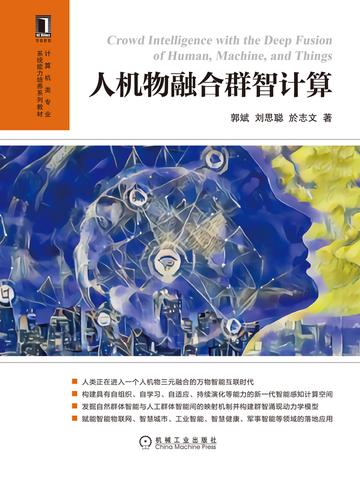
Overview: With the rapid development and accelerated integration of IoT and artificial intelligence technology, the intelligent Internet of Things (AI in IoT, AIoT) is growing into an emerging frontier field with broad development prospects. IoT intelligent applications and services have gradually been integrated into various areas of major national needs and people's livelihood, such as smart cities, smart manufacturing, driverless driving, smart agriculture, health, national defense and military, etc. In the context of the intelligent Internet of Things, the three basic elements of people (smartphones, wearable devices, etc.), Machines (cloud devices/edge devices), and things (Internet of Things terminals) are moving toward collaboration and integration, heading towards the era of human-machine-thing integration and crowd intelligence computing. Human-machine-object integrated crowd intelligence computing (CrowdHMI) refers to the use of the difference in human/machine/object perception capabilities, the complementarity of computing resources, and the interactivity between nodes to solve complex problems that are difficult to solve with a certain kind of intelligence alone through collaborative sensing, distributed learning, and crowd intelligence knowledge transfer, and then build a smart space with self-learning, self-organization, adaptability, and transferability capabilities. Its potential research challenges include the mechanism of human-machine-object crowd intelligence fusion, human-machine-object collaborative crowd intelligence sensing, self-learning enhancement and adaptive evolution (deep model compression, transfer learning, meta-learning, lifelong learning, etc.), And group distributed learning models (edge intelligence, device-edge-cloud collaborative computing, multi-agent reinforcement learning, federated learning, etc.). This book will introduce you to the basic theories, conceptual models, research challenges, key technologies, and typical applications of human-machine-object fusion crowd intelligence computing, and provide an outlook on its future development direction. This book can provide innovative development perspectives and relevant theoretical, methodological and technical support for scientific researchers and IT practitioners in the Internet of Things, artificial intelligence, industrial Internet, smart cities, intelligent manufacturing and other fields. It can also be used as a textbook for senior undergraduate and graduate students in related majors.
Reader comments
Wow, this book sounds so cool! It explores the era of crowd intelligence computing where humans, machines, and things integrate, and also mentions solutions to many complex problems. It feels like it will have a great impact on the future development of science and technology. This reminds me of those virtual worlds and intelligent systems in "The Matrix". Maybe one day we will really live in such a world. Moreover, the authors are all very powerful scholars, and their research must be very valuable. I think this book will be a book worth reading for people who are interested in technology and the future.


Wow, this book sounds so cool! It explores the era of crowd intelligence computing where humans, machines, and things integrate, and also mentions solutions to many complex problems. It feels like it will have a great impact on the future development of science and technology. This reminds me of those virtual worlds and intelligent systems in "The Matrix". Maybe one day we will really live in such a world. Moreover, the authors are all very powerful scholars, and their research must be very valuable. I think this book will be a book worth reading for people who are interested in technology and the future.