Read Good Books Together
I want to watch something similar to "Cold Legend". I love reading, so I also want to write a book, so I came to Tomato to read. A good book affects several generations and has the mark of the times and history. Therefore, when I discover a good book, I recommend it to you. This good book is a must-have.
3.6kViews59Books2moUpdated
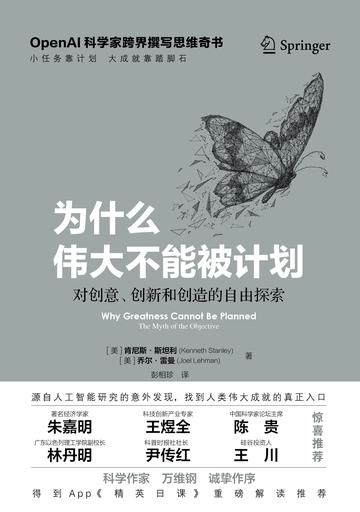





Greatness cannot be planned because creation often results from the exploration of novelty rather than a preset path. Human beings rely on goals and plans to think about it, and it is difficult to explain the unexpectedness of breakthrough innovation. The more obsessed you are with clear goals, the easier it is to fall into local optima, narrow the scope of exploration, and miss key non-intuitive paths. Goal orientation is suitable for simple systems such as report making and item distribution, but will fail in complex innovative systems such as scientific research and entrepreneurship. Innovation has no preset goals and relies on diversity, trial and error, and occupation of new ecological niches to accumulate complexity, just like biological evolution. Stepping Stone Model Gain experience through trial and error in small steps. Greatness is a series of unpredictable stepping stones whose value lies in opening up new possibilities, not in getting closer to a preset goal. These stepping stones may seem useless at the time, but they can connect to a path to greatness in the future. As the book says, bicycle technology was a key stepping stone to airplanes, and radar development gave rise to microwave ovens. Novelty Exploration Proactively seek out unexplored territory. Give up rewards that are closer to the goal, instead use novelty as the screening criterion, and continue to explore unexplored areas. Novelty automatically accumulates information and complexity, and eventually the ability to solve complex problems emerges, while goal orientation often converges to local optimal solutions prematurely. Summary Suddenly I want to use the algorithm of the acm competition to make an analogy and make a reading summary. The traditional goal setting and goal pursuit is like a greedy algorithm. Each step chooses the one closest to the end point, and it is easy to fall into local optimality, which is the target deception mentioned in the book. The book follows novelty and accumulates stepping stones, just like dynamic programming, decomposing sub-problems, looking for aftereffects that are not kidnapped by the unknown final goal, and making state transitions through a series of unpredictable stepping stones. Give up the obsession with the global optimal path. Life's problems are high-dimensional, complex, and uncertain problems. There is no optimal path that can be calculated in advance. Just like dynamic programming, it will not calculate the entire optimal route at the beginning, but will push it out step by step. Just ask what new states the current state can reach, not how far it is from the end; Don't be kidnapped by the idea of what I want to be at the age of 35 and what I must accomplish; Think more: Is this novel enough? Can it bring new abilities and perspectives? Multiple replays: Pay attention to every small choice and don't be perfunctory; Review and think about every failure to pave the way for the future; Failure is not a loss, it helps you eliminate invalid states and make subsequent transfers more accurate.
The point of view of this book is very novel. It challenges our traditional way of thinking and reminds me of the book "Black Swan". The "treasure hunter thinking" and other methods in the book are also very practical. Just like Steve Jobs in "The Biography of Steve Jobs", he doesn't follow common sense but can create great products.
You can see the limitations of "goal-oriented thinking" in this book, as well as the coordination of cooperation and switching between non-goals and goals. The non-goals described by the author are innovation, which makes us stop and look at the process instead of "problems → results". The process is an ever-changing mine with treasures, and each person digging for treasures is a treasure hunter with different tools (talent, talent, acquired hard work, etc.). The treasure is never fixed and rigid, it is almost unique. What is important is the process, not the results.
The discovery of this book undoubtedly conflicts with traditional civilization, but it also proves the existence of free will. If we, who are born with disabilities, want to break free from the shackles of fate, the key is free will.
This book mainly emphasizes non-goal exploration. Some goals (high-level and ambitious goals) are deceptive inducements or constraints. When you measure whether you are close to the goal, you are actually getting further and further away. And often great achievements that achieve disruptive changes in the industry do not set specific goals at the beginning, which means they grow wildly! It may not be applicable to all events, but the ideas in this book are worth reflecting on.
Follow your heart and do whatever you want.
"Tall and lofty" goals are out of reach, so it's better to set small, simple and executable goals.
A very nice book
It expanded my thinking and fully demonstrated that human potential is unlimited. Only by constantly digging deeply and constantly changing can we discover a better self.
The story is told based on arguments and viewpoints, and the author often guides us to think about why this matter is... Reasonable, logically clear, and can be eaten with confidence
There are many interesting points of view and it is very beautiful. Be careful of your "common sense" becoming an ingrained bias. A good way to do this is to question this common sense