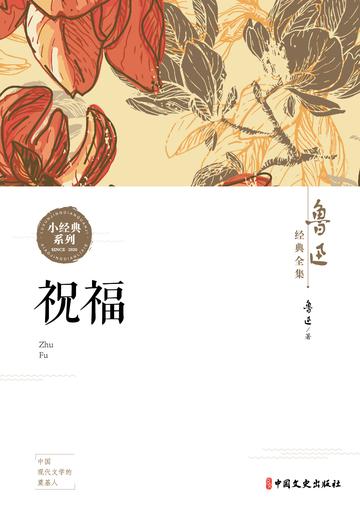
This volume includes "Blessings", "Only Collection", "Collection Outside Collection" and "Supplement to Collection Outside Collection".
"Blessing" is a short story written by Lu Xun, a writer during the Republic of China. It was written on February 7, 1924. It was first published in the Shanghai "Oriental Magazine" bimonthly, Volume 21, No. 6, Published on March 25, 1924, and was later included in the novel collection "Wandering". The work tells the story of "I", an intellectual who left his hometown. After returning to his hometown at the end of the lunar calendar, he stayed at the house of his fourth uncle (Master Lu Si) to prepare a "blessing". He witnessed the tragic death of Xiang Lin, the former maid of the fourth uncle's family. By describing Xianglin's tragic life, the novel shows the author's sympathy for oppressed women and his ruthless exposure of feudal thoughts and ethics. It also explains how enlightened intellectuals like "I" in the article were indifferent and overwhelmed by the current social situation of people's selfishness and the harsh world at that time.
"Just Collection" Faced with the reactionary warlords' massacre of revolutionaries and progressives, Mr. Lu Xun was both resentful and powerless, "In the past six months, I have seen a lot of blood and a lot of tears, but I only have mixed feelings. The tears are gone, the blood is gone, and the butchers are free and easy again, some with steel knives, and some with soft knives. But I only have 'mixed feelings'. Even the 'mixed feelings' have been 'put where they should go', so I can only have 'that's it.'"
"Jiwaiji" is a collection of poems and essays that have not been included in the author's essays published before 1933. The "Supplement to the Collection of Collections" includes the lost articles that were discovered after the publication of the "Collection to the Collection" compiled by Xu Guangping in May 1938. Among them, advertisements, notices, corrections, etc. Are compiled into Appendix One; those recorded from other people's works are compiled into Appendix Two. The main contents include a brief discussion of Chinese geology, the theory of breaking evil voices, the birth statement of "Yue Duo", the travel records of Xinhai, the opinions on the art of Qinbobu, the school notes of "Maitreya Chongge Stele of Dayun Temple", the endorsement of the abolition of the "Education Outline", the examination of the stone seals of Yu Temple in Kuaiji, etc.
Reader comments
The book "Blessings" touched me deeply, and the plight of Mrs. Xianglin is really very sympathetic. Her whole life was a victim of the feudal ethics of that era. Just like some elders around me, they are bound by old ideas and live a very miserable life. The indifference of "I" in the book also reminded me of my own helplessness sometimes. However, I still like the plot of "Xiang Lin's Sister-in-law donates the threshold" very much. She thought this could change her destiny, but in the end she still could not escape the tragic ending. This made me realize more deeply the cruelty of feudal society. In short, this is a very meaningful book and I recommend it to everyone.
The collection of essays is also quite interesting. I couldn't understand it at first and couldn't read it. Then I still couldn't quite understand it, but I found it interesting. In the end, I could understand it a little and it became even more interesting. When you are forty or fifty years old, if you still have a hobby of reading, you will have to dig out this book and read it again. You should be able to understand it better.
Finish reading this book on October 30, 2024
Although I only half understand it, my horizons have been broadened and my speaking language has become richer. It turns out that I can be so polite and insulting [laughing]
The book "Blessings" touched me deeply, and the plight of Mrs. Xianglin is really very sympathetic. Her whole life was a victim of the feudal ethics of that era. Just like some elders around me, they are bound by old ideas and live a very miserable life. The indifference of "I" in the book also reminded me of my own helplessness sometimes. However, I still like the plot of "Xiang Lin's Sister-in-law donates the threshold" very much. She thought this could change her destiny, but in the end she still could not escape the tragic ending. This made me realize more deeply the cruelty of feudal society. In short, this is a very meaningful book and I recommend it to everyone.
The collection of essays is also quite interesting. I couldn't understand it at first and couldn't read it. Then I still couldn't quite understand it, but I found it interesting. In the end, I could understand it a little and it became even more interesting. When you are forty or fifty years old, if you still have a hobby of reading, you will have to dig out this book and read it again. You should be able to understand it better.
Finish reading this book on October 30, 2024
Although I only half understand it, my horizons have been broadened and my speaking language has become richer. It turns out that I can be so polite and insulting [laughing]